
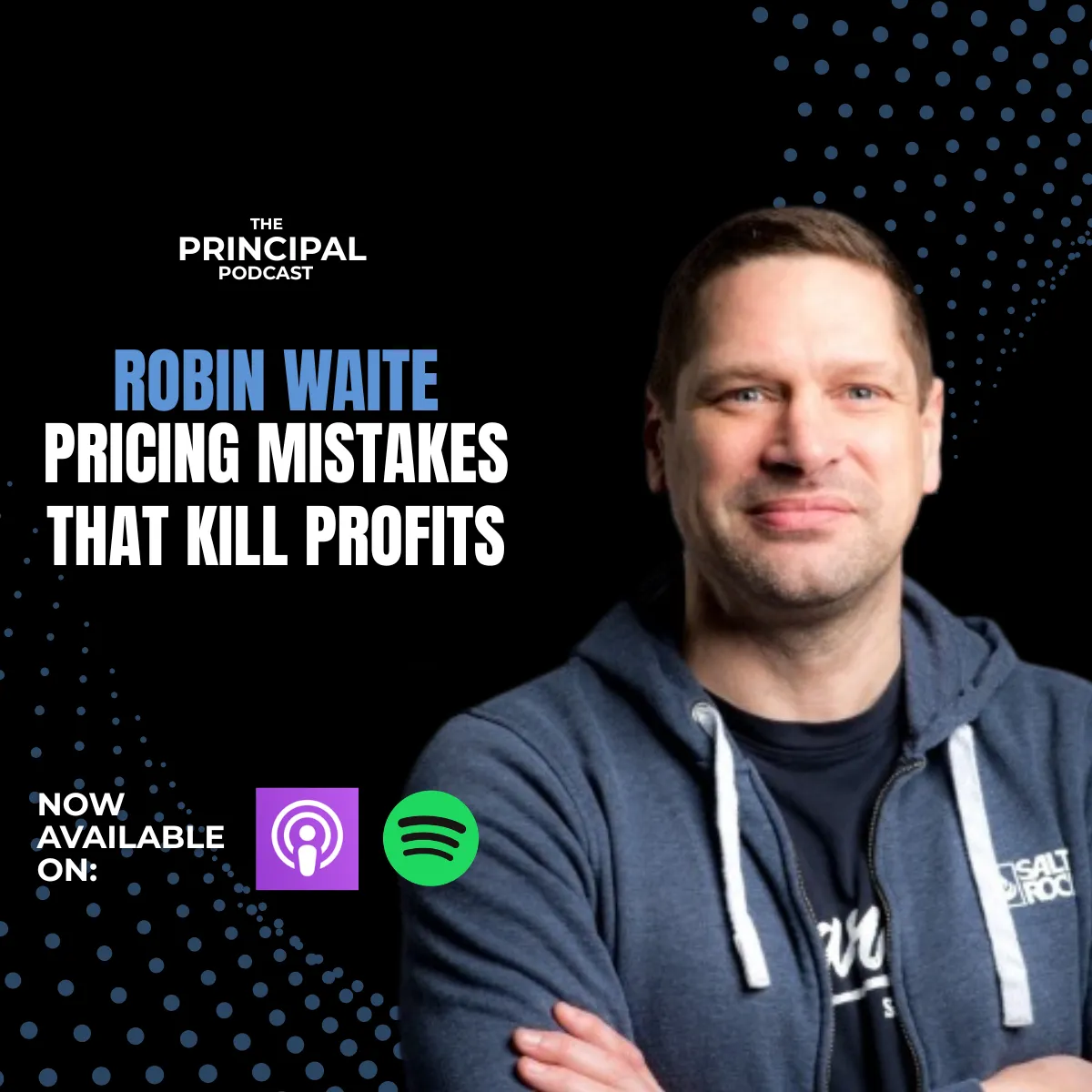
Robin Waite on why hourly pricing caps consultant earnings, how goal-focused pricing works, and why strategic partnerships beat content marketing.
Most consultants assume they have a marketing problem. Robin Waite has spent nine years proving otherwise. The real constraint is almost always pricing and capacity, and fixing either one changes everything else.
In this episode of The Principal Podcast, host John Degnan sits down with business coach Robin Waite to explore why hourly pricing creates an invisible ceiling on consultant earnings and what to do instead. Robin shares the goal-focused pricing framework he uses with coaches, consultants, and freelancers, explains how selling outcomes rather than time unlocks both higher fees and better client results, and reveals the partnership-led growth strategy that replaced a full content machine and generated hundreds of thousands of dollars in new business from a single podcast appearance.
This article breaks down their conversation into practical steps for coaches, consultants, and freelancers who want to charge more confidently, reduce their dependence on constant hustle, and build a business with real financial breathing room.
Robin spent 12 years running a marketing agency that grew to around $300,000 in annual revenue. By the end, though, the business was running him rather than the other way around. Late nights, client messages at weekends, a small team to manage, and the imminent arrival of a second child combined into a pressure that proved unsustainable.
The moment of clarity came on a Sunday morning cycling ride, freewheeling at 52 and a half miles per hour down a hill. Robin broke down emotionally at the bottom, made his way back to the cafe where his cycling friends were waiting, and went home to tell his wife he was closing the business. It was, he says, the best decision he has ever made, even if it did not feel that way at the time.
Rather than close without value, Robin found a buyer for the agency's client book and intellectual property, including early ideas around productising services and pricing that form the foundation of his coaching work today. The earnout gave him the breathing room to spend time with his family and think carefully about what came next.
What came next was coaching, by accident. People at networking events kept asking how he had grown and exited. Informal conversations over coffee turned into mentoring, which turned into a formal coaching practice in 2017. Robin quickly realised that the challenges he had faced in his agency were not unique; they were near-universal among small business owners.
The standard business projection for a new consultant goes like this: 40 hours per week multiplied by an hourly rate multiplied by 4.2 weeks equals a monthly income figure. Robin describes this as one of the most misleading calculations in consulting.
In practice, the average coach, consultant, or freelancer has roughly two billable days available per week. The rest is consumed by accounting, admin, marketing, sales conversations, school runs, and every other element of running a business and living a life. The ceiling is structural, not motivational; working harder does not move it.
The answer is to decouple income from hours entirely. Once time is removed from the equation, the question becomes what result the client actually needs and what that result is genuinely worth. That shift in framing is where the goal-focused pricing framework begins.
Robin's goal-focused pricing framework begins with a target income and works backwards. Take a consultant who wants to earn $100,000. If they currently charge $1,000 per client engagement, simple division reveals they need 100 clients this year. Robin says that, at this point, most business owners' eyes pop out of their heads.
The follow-up question is equally clarifying: how many clients could you realistically attract, enrol, and serve in a year? Twenty is a common answer. Divide $100,000 by 20 and the required fee per client becomes $5,000. The maths is not complicated; the shift in thinking is.
The job then becomes identifying what additional value can be built into a $5,000 engagement to make it a full and remarkable solution for the client. Not simply adding zeros to the current price, but genuinely redesigning the offer around the client's outcome and everything required to deliver it reliably and well.
One of Robin's sharpest observations is about what happens to consultants as they improve. An experienced designer who can build a website in a day produces the same result as a newcomer who takes a week. Under hourly pricing, the newcomer earns more. The logic is entirely backwards.
Outcome-based pricing resolves this by anchoring the fee to the deliverable rather than the process. A website that generates leads is worth a defined price whether it takes one hour or 100 hours to produce. The client's value is in the outcome; the consultant's value is in delivering it efficiently and reliably, every time.
This same principle applies across service businesses. Robin regularly challenges therapists who offer bulk session discounts to think about it differently: if a client gets better results from a block of 12 sessions than from a single one, why does the higher-value option cost less? The experienced professional who gets clients better results faster should be commanding a premium. That is the argument for pricing strategy rooted in outcomes rather than inputs.
By the end of 2022, Robin had calculated that his content marketing operation was consuming 30 to 40 hours per week across him and his team. Short-form video, long-form posts, email newsletters, every social platform. The business was successful; the effort-to-output ratio was not. He stopped.
In 2023, he pivoted to a partnership model. The approach is patient and deliberate: identify influential people with audiences that genuinely overlap with his own, invest time and energy in building a real relationship, add value without expectation, and let the compound effect pay out over time. Robin spent roughly two years working with Ali Abdal's team on product launches, contributing without charging, before earning an invitation onto Ali's Deep Dive podcast.
That single appearance generated 3,000 leads and around $400,000 in new business. Robin has since replicated the approach with Chris Do (2.5 million subscribers in the creative space), Nisha (two million subscribers as a finance educator), and Daniel Priestley. His current marketing strategy is deliberately simple: speak on stages, guest on podcasts, and give away as many signed copies of his book as possible.
Many consultants believe discounting is a harmless way to close a deal. Robin's analysis of the profit and loss account tells a different story. A 10% discount does not require 10% more sales to compensate; once the reduction works through net margin, approximately 22% more volume is needed to produce the same profit. At a 20 to 25% discount, double the volume is required just to stand still.
The reverse calculation is equally powerful. A consulting business with $1 million in turnover at a 10% net profit margin earns $100,000. Raising prices by just 10%, with no change in costs or expenses, doubles the profit in a single move. Turnover is vanity, profit is sanity, cash is king: it is a cliche because it is true.
Rather than discounting, Robin advocates two alternatives. First, stack value into the offer until the price feels obviously justified. Second, introduce upfront payment terms: requesting 25% to 50% of the fee in advance creates positive cash flow cycles and removes the constant pressure of chasing invoices. For most consulting engagements, front-end work is involved anyway, which makes an advance payment easy to justify on both sides.
Days 1 to 30 - Diagnose the model: Map your current services against the outcomes they deliver for clients. Identify which results clients most value and what those outcomes are actually worth to them. Apply Robin's goal-focused pricing formula: set your income target, decide how many clients you can realistically serve, and divide one by the other to find your required fee per client.
Days 31 to 60 - Rebuild the offer: Redesign at least one service as a productised package anchored to a clear outcome rather than an hourly rate. Stack additional value, whether that is a guarantee, a faster delivery timeline, or extended support, until the package feels fully justified at the new price. Test it with two or three prospects before rolling it out across the board.
Days 61 to 90 - Build financial resilience: Introduce upfront payment terms for new clients, starting at 25% and moving towards 50% where the relationship allows. Use the improved cash flow to begin building a reserve. Robin's benchmark is six to 12 months of operating costs: enough runway to stop chasing clients out of necessity and start making deliberate decisions about who you work with and why.
"My clients won't pay more." This is the most common objection Robin encounters, and almost always a positioning issue rather than a market one. Before accepting that ceiling, it is worth asking whether the value of the outcome has been clearly communicated, or whether a higher number has simply been stated without context. Clients pay for certainty and results; the conversation changes when the offer is framed around what they gain rather than what you charge.
"I need to discount to stay competitive." Discounting feels like a practical solution in the moment. A 10% discount requires approximately 22% more volume to produce the same net profit; before reducing the price, the more useful question is what could be added to the package to make the full price feel more than justified.
"I can't find enough clients at a higher price." The goal-focused pricing framework often reveals that fewer clients are needed than originally assumed. Twenty clients at $5,000 is both more achievable and more sustainable than 100 clients at $1,000. The real question is not whether higher-paying clients exist; it is whether the offer and positioning are compelling enough to attract them.
What Robin Waite describes on The Principal Podcast is not a complicated system. It is a shift in perspective: from selling time to selling results, from chasing volume to serving fewer clients well, and from reacting to cash flow pressure to building the kind of financial buffer that makes calm, deliberate decisions possible.
The goal-focused pricing framework works because it starts from what the business actually needs to achieve, not from what an hourly rate calculator suggests. The partnership strategy works because it builds genuine relationships over time rather than competing for attention in an algorithmic feed. Neither approach is quick; both are sustainable in ways that a content treadmill simply is not.
For service business owners ready to take that first step, the right starting point is usually a clear conversation about business development and what a more structured approach to pricing could mean for the long-term health of their practice.
The Principal Podcast, hosted by John Degnan, is a show for founders, managing partners, and leaders in professional services who want to understand how the best consulting firms grow and sustain themselves. Each episode goes deep on the strategies behind firm growth, from winning clients and building trust to scaling teams and staying ahead in a competitive market. The podcast is produced by GHA Marketing, a specialist podcast agency helping B2B businesses use podcasting to generate leads and build lasting authority in their markets.
Watch this episode on YouTube.



Answer 40 questions and we’ll send you a personalised report with feedback tailored to your specific needs. It's quick and free and you get a FREE copy of Take Your Shot.
This Scorecard has been designed to show Coaches, Consultants and Freelancers their blind spots and provide instant, actionable steps on how to increase their prices.


