
April 12, 2022

July 29, 2026

Editorial Disclaimer
This content is published for general information and editorial purposes only. It does not constitute financial, investment, or legal advice, nor should it be relied upon as such. Any mention of companies, platforms, or services does not imply endorsement or recommendation. We are not affiliated with, nor do we accept responsibility for, any third-party entities referenced. Financial markets and company circumstances can change rapidly. Readers should perform their own independent research and seek professional advice before making any financial or investment decisions.
Hybrid cloud has left the fringe. Gartner projects that nine out of ten organisations will blend on-prem and public resources by 2027 (Gartner). According to Canalys, vendors are pouring fresh funding into programs that help channel partners, who already influence 70 percent of global IT spend, capitalise on this shift.
Choosing a hybrid platform, however, is messy. Hyperscalers now ship on-prem gear, data-centre stalwarts sell -as-a-service bundles, and software vendors promise cloud agility on any server, each with different realities.
In this guide, we rank five platforms that balance technical depth, channel profit, and future-proof road maps. Expect:
Need a turnkey bundle? Distributors such as TD SYNNEX package modern IT infrastructure, from servers to cloud services, so you stay focused on value, not components.
Ready? Let's explore how you and your clients can win big in hybrid, starting with our scoring method.

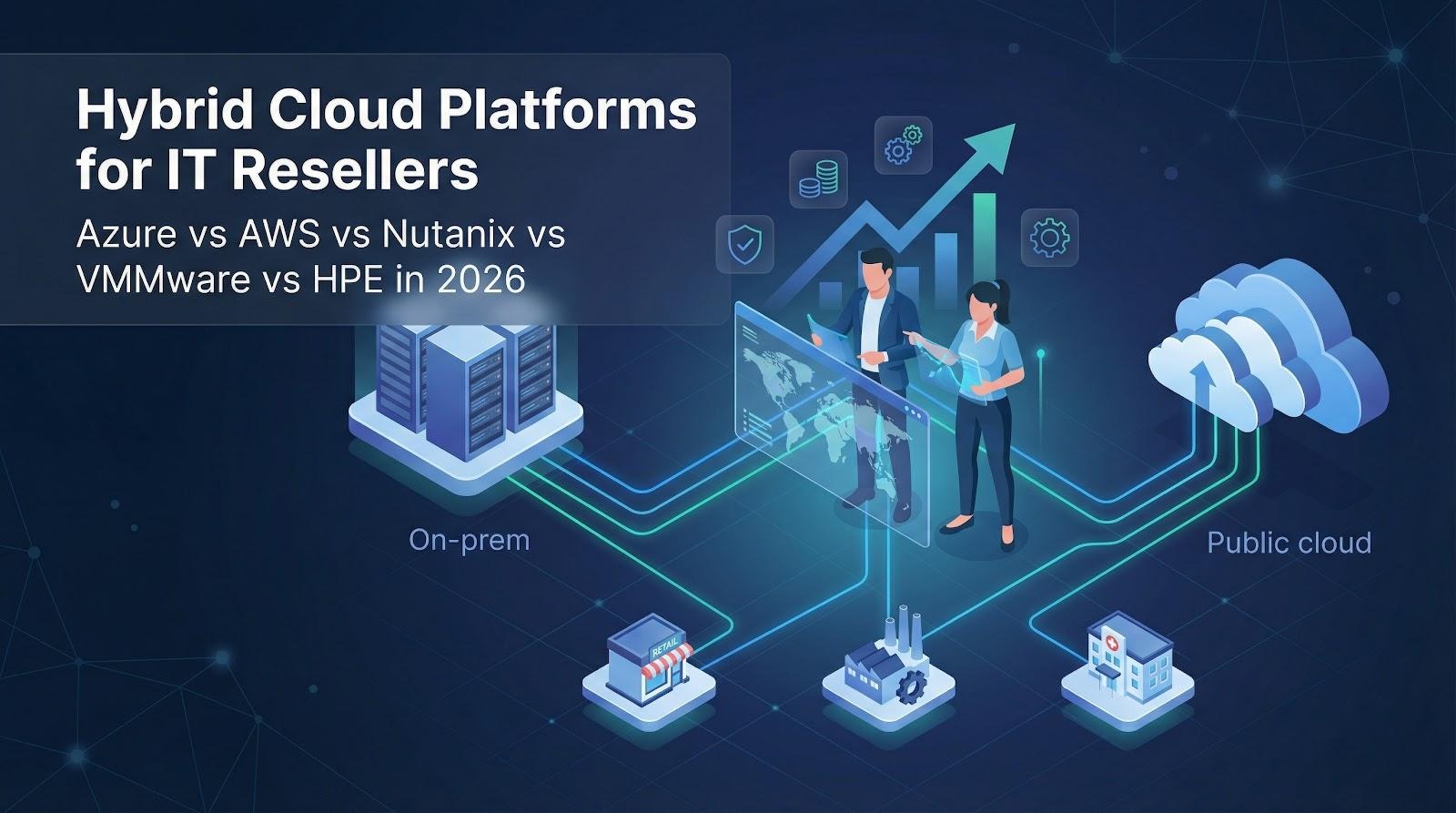
Customers once asked if they should mix on-prem and cloud; now they ask how soon. Gartner expects hybrid adoption to reach 90 percent by 2027, and IDC forecasts spending on modern IT infrastructure to surpass $225 billion in the same timeframe-figures that speak volumes.
When demand shifts this sharply, vendors follow the money. They direct generous program funds, MDF, and technical resources through the channel, because partners still influence roughly 70 percent of global IT spending. One distributor executing this playbook is TD SYNNEX.
Its no-cost Practice Builder program includes seven paths aligned with Microsoft's Cloud Partner Program, giving solution providers templated business plans, training, and marketing kits that cut the complexity of building an Azure-based hybrid practice.
For hands-on validation, TD SYNNEX's Innovation Studio in Clearwater, Florida lets partners prototype hybrid-cloud architectures and AI workloads on real equipment, turning multi-week proof-of-concept cycles into guided workshop days.
Hybrid wins, and it wins through you.
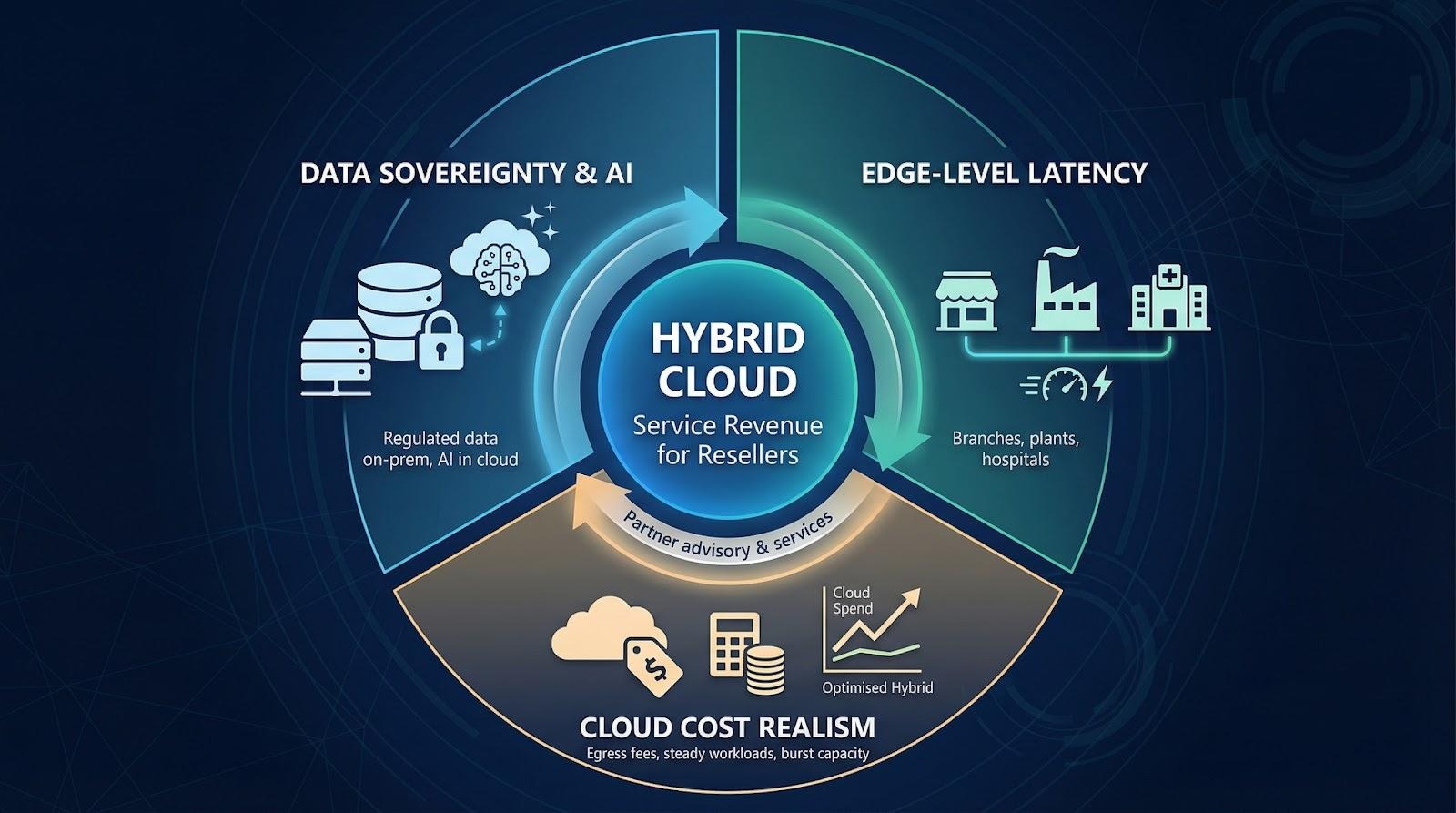
Why are buyers doubling down? Three forces appear in almost every board-level discussion we join:
For resellers, these drivers translate into durable service revenue. Clients need help sizing footprints, wiring governance, and decoding pricing models that read like airline fare charts. Master hybrid and you secure that advisory role.
The next sections show where to place your bets: platforms that match this momentum and reward partners for doing the heavy lifting.
Choosing a platform shouldn't feel like throwing darts. We applied a clear, channel-centric rubric so you can see why one vendor ranks above another, with no black-box magic.
We began with a blunt question: Does this solution let you manage true hybrid workloads while earning healthy margin? If not, the vendor never made the shortlist.
For those that did, we graded them on six weighted factors:
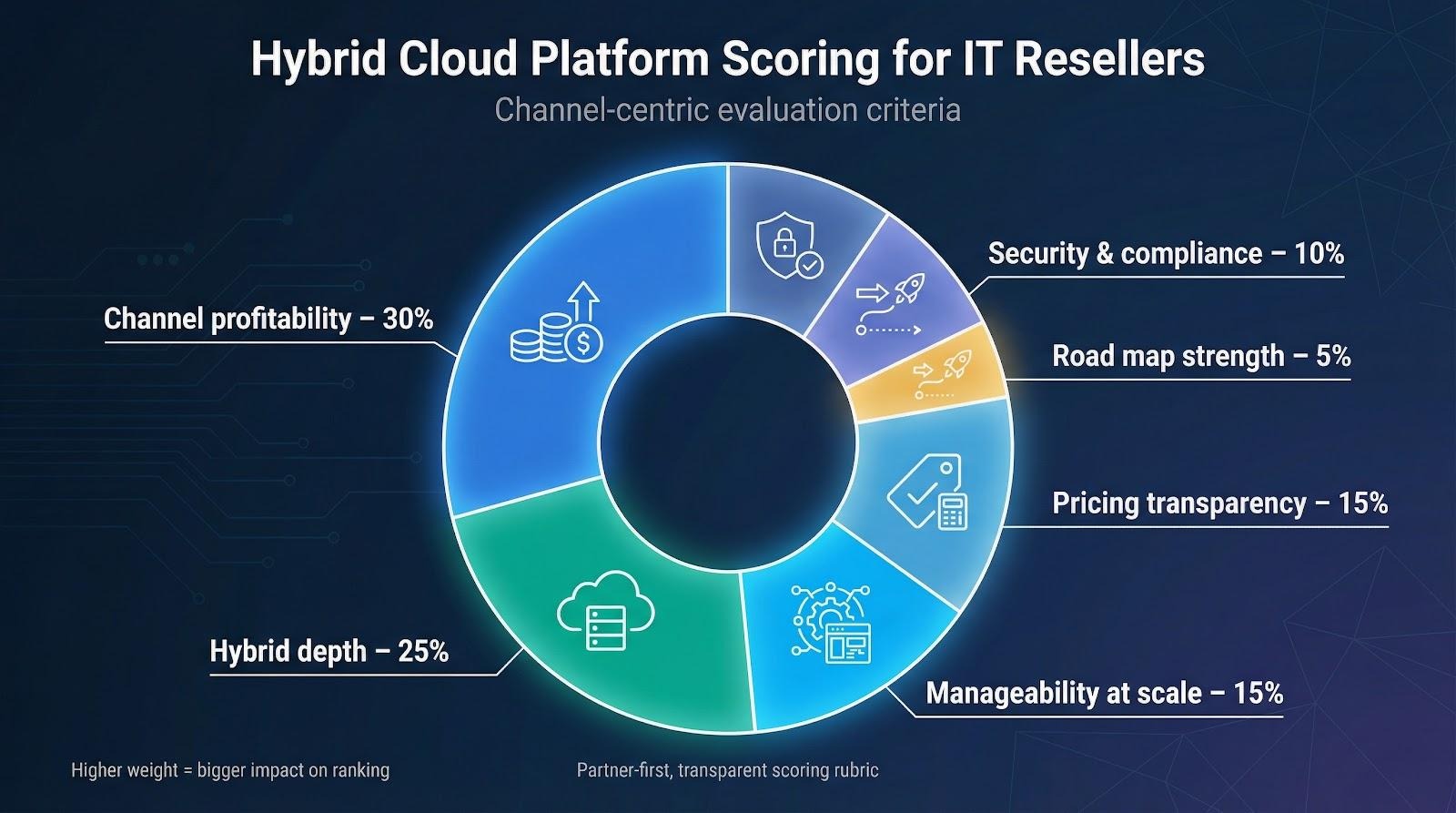
Channel profitability (30 percent)
Nothing matters more than the dollars that flow back to your firm. We reviewed program discounts, rebates, deal-registration boosts, and the ease of adding your own managed services.
Hybrid depth (25 percent)
A badge that says "hybrid" is cheap; delivering smooth workload portability is hard. We favoured platforms that run the same services on-prem and in cloud, or at least manage multiple environments from one control plane.
Manageability at scale (15 percent)
Multi-tenant console? Automated patching? API hooks for your PSA? Those touches turn complex estates into repeatable revenue.
Pricing transparency (15 percent)
If you need a PhD to quote a solution, clients lose trust, and deals stall. Clear per-core, per-node, or pay-as-you-go models scored higher than opaque bundle pricing.
Security and compliance (10 percent)
Built-in encryption, zero-trust frameworks, and industry certifications keep regulators, and your liability insurer, happy.
Road map strength (5 percent)
Finally, we checked the vendor's public investment signals: recent feature releases, acquisitions that broaden the platform, and analyst quadrant momentum.
We tallied the numbers, then tested them against real-world partner chatter (what MSP forums praise and what they criticise). The result is a ranking that balances headline features with day-to-day reseller realities.
In the next section, we'll examine the first platform on our list and show how it measures up against every point above. Grab another sip of coffee; this is where the rubber meets the revenue.
Azure tops our ranking for one reason: it meets customers where their workloads already live and rewards partners who guide that journey.
Picture a bank that keeps core lending software on-prem for compliance yet experiments with OpenAI models in the cloud. Azure Stack HCI locks sensitive data inside the bank's racks, while Azure Arc projects those servers into the same portal that governs public-cloud VMs and Kubernetes clusters. One policy engine, one billable story, no whiplash for the ops team.
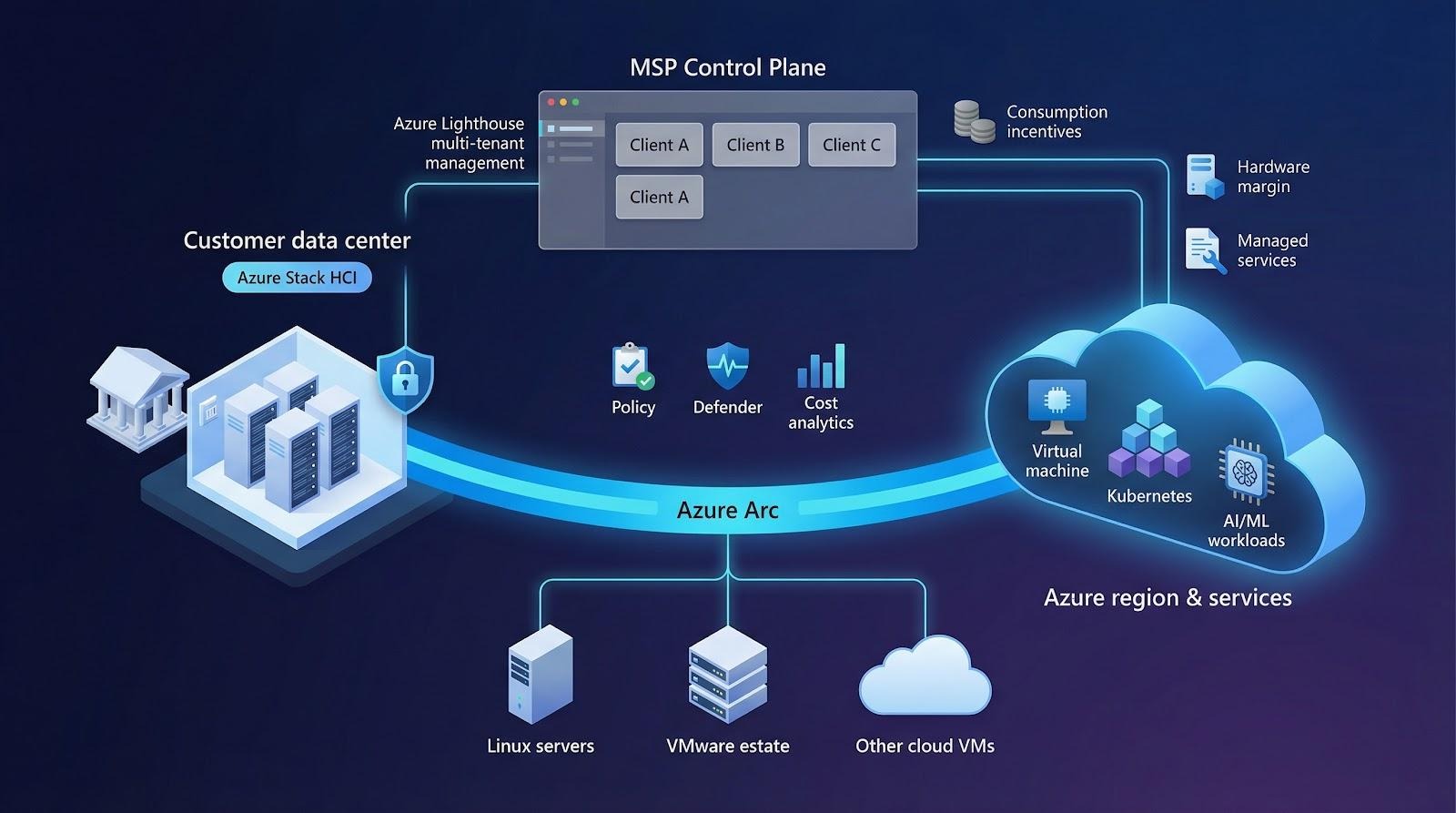
Arc's unified control plane is the standout feature. We can enrol bare-metal Linux boxes, VMware estates, or even an AWS EC2 fleet, then apply Azure Policy, Defender, and cost analytics from one dashboard. For managed-service providers the impact is huge: you scale your tooling once, then extend it to every client tenancy through Azure Lighthouse.
Channel economics hold up as well. Azure consumption margins start modest, but Microsoft stacks incentives such as usage accelerators, solution-assessment rebates, and co-op marketing funds that often push effective profitability into the mid-teens. Stack HCI adds hardware margin through OEMs (Dell, HPE, and Lenovo) plus a predictable per-core software subscription. Because Arc's base services are free, you can deploy governance features as a land motion and upsell premium monitoring or Defender SKUs later.
Pricing stays clear: Stack HCI runs about ten dollars per core per month, while pay-as-you-go Arc add-ons follow the same rate card customers already know from Azure. No arcane capacity commits, no three-year leases.
Where should you pause? First, minimum hardware. A single-node cluster is supported, but a highly available production Stack HCI cluster still needs at least two certified nodes, so micro-clients may hesitate. Second, skills. Your engineers must speak ARM templates, Entra ID, and, increasingly, Bicep. The learning curve is real, yet Microsoft's free sandbox labs and exam vouchers soften the blow.
Bottom line: if your customer base already relies on Windows, SQL, or M365, Azure hybrid lets you deepen wallet share without ripping out familiar tech. For most VARs and MSPs, that moves Azure from safe bet to strategic backbone.
If Azure meets legacy Microsoft estates, AWS owns the cloud-native crowd. Outposts carries that strength straight into customer data centres, retail stores, and factory floors without a single code change.
At its core, Outposts is a slice of AWS region hardware delivered as 1U, 2U, or full-rack appliances. Your customer still provisions EC2, S3, or RDS, but latency drops to microseconds. The same consoles, the same APIs, the same automation scripts, only the zip code changes.
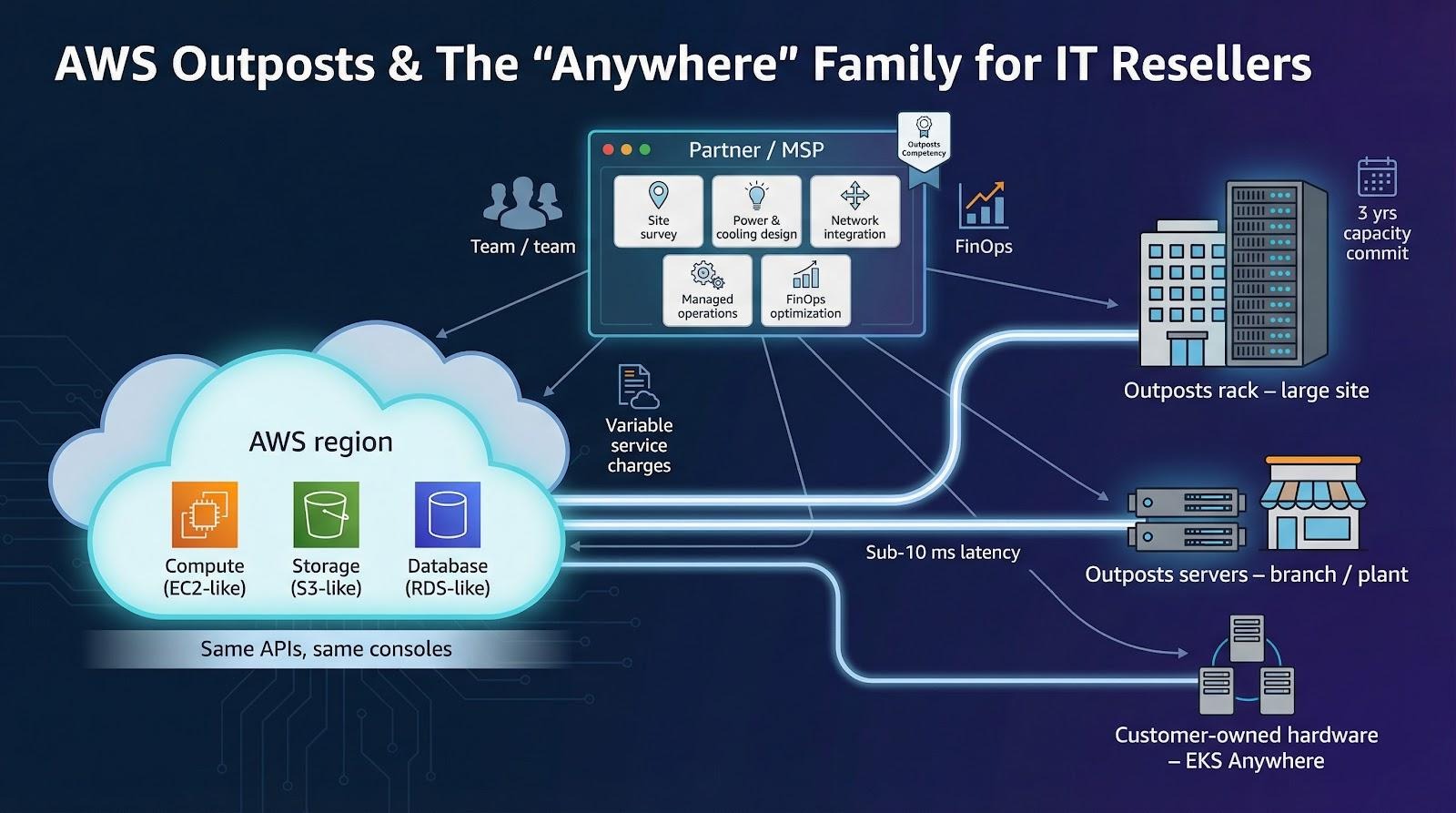
For partners, resale margin on raw AWS usage is thin, so the play is services. You architect power, cooling, and network, handle site surveys, and manage the stack after installation. AWS provides Competency badges and marketing funds once you close a few deals, but your real profit comes from ongoing optimisation, patching, and FinOps.
Pricing needs careful choreography. Hardware is committed for three years and billed monthly, and variable service charges stack on top. Treat the quote like an airline itinerary: lock seating (capacity) first, then estimate in-flight meals (data transfer) so the CFO avoids sticker shock.
What about smaller clients? AWS responded with Outposts servers and EKS Anywhere, letting you run Kubernetes on customer-owned hardware while still piping telemetry back to the cloud. It costs less yet keeps the management story consistent.
Caveats? Expect long lead times for full racks, and remember that AWS often leans toward direct sales. Register deals early to avoid channel conflict, and make your value as the trusted local operator unmistakable.
When your customer base already speaks CloudFormation and needs sub-ten-millisecond response in a plant or branch, Outposts feels like a familiar tool. The partner who masters deployment details will lock in years of managed-service renewals.
Not every customer wants a hyperscaler-branded rack humming in the corner. Many just need private-cloud simplicity without vendor lock-in. That is where Nutanix shines, and where partners can differentiate fast.
Think of Nutanix as a self-driving data centre. You install the software on almost any x86 hardware, pool compute and storage into one resilient fabric, then spin up VMs or containers with a Prism dashboard click. No storage arrays to babysit, no complex SAN zoning, and zero licensing gymnastics if you adopt the AHV hypervisor.
For resellers, the channel story is straightforward. Nutanix sells almost exclusively through partners, protecting registered deals and offering discounts that usually start around twenty percent. In 2023 the company added further incentives, raising Elevate rebates and allowing transactions through AWS and Azure marketplaces, so you can earn margin whether the cluster lives on-prem or in the cloud.
Hybrid flexibility is built in. With NC2 you can move an on-prem Nutanix cluster to AWS or Azure bare-metal nodes in hours, not weeks. Your client's IP scheme, security policies, and management tools travel with it, sparing them the refactor tax. That same mobility lets you deliver disaster-recovery services with minimal extra learning for your ops team.
Costs stay predictable. Licensing follows a per-core subscription, independent of hardware, which lets you upgrade servers without repurchasing software. For SMB and mid-market clients you can start with a three-node cluster and expand as workloads grow, a sales motion that aligns nicely with monthly recurring revenue.
Where should you pause? Nutanix lacks the brand recognition of a hyperscaler, so you will spend extra cycles educating execs who equate "cloud" with AWS. If a customer is deeply invested in VMware, prying loose ESXi can cause friction, even though Nutanix can manage those hosts side by side.
Still, for partners who built expertise on servers and storage, Nutanix offers a modern bridge to cloud economics without giving up hardware margin or operational control. It is a pragmatic choice when clients want private-cloud polish, public-cloud agility, and a vendor that puts the channel first.
VMware sits in more enterprise data centres than any other virtualisation stack, which makes its hybrid story both powerful and, after the Broadcom takeover, a bit more complicated.
Let's start with the upside. If your client already trusts vSphere, extending workloads to VMware Cloud on AWS or Azure VMware Solution feels like swapping parking spots, not vehicles. vMotion still works. vCenter still governs policy. Your migration project becomes a weekend change window instead of a six-month refactor marathon.
That continuity is gold for partners. You bill assessment, migration, and run-state services without redrawing application diagrams. Many customers view VMware as the safest path to cloud portability: run the same architecture on-prem, in AWS, or in hundreds of third-party clouds. No vendor offers a larger ecosystem of certified service providers.
Channel economics remain solid, with roughly twenty percent discounts on perpetual or subscription bundles, plus deal-registration protection. Broadcom's new licensing model bundles core products into VMware Cloud Foundation subscriptions. This shift simplifies quoting but raises the entry price, so guide budget conversations early.
What are the watch-outs? Sticker shock is one. Clients who once bought vSphere alone now pay for the full suite. Some react by weighing Nutanix or open-source KVM. Your defence is speed: show how staying on VMware cuts migration risk and uses existing staff skills.
Support perception is another concern. Partners report longer ticket queues post-acquisition, even though official SLAs have not changed. Mitigate by wrapping your managed service around it, taking level-one calls and escalating only genuine code issues.
Finally, remember VMware's sweet spot: large estates packed with legacy VMs. If your portfolio leans toward cloud-native startups, steer them to container platforms instead. For banks, healthcare systems, and global manufacturers that want cloud agility without disruption, VMware remains the comfort-food choice—and you, the chef who plates it perfectly.
GreenLake flips the classic hardware sale on its head. Instead of sending a huge cap-ex invoice, you give clients a cloud-like pay-per-use model while servers remain in their racks or a partner-hosted colo. For organisations tired of public-cloud bill shock yet wary of forklift upgrades, that proposition hits the right note.
HPE installs and meters the gear, and partners orchestrate everything around it. You size baseline capacity, monitor utilisation, and layer on managed services. Revenue shifts from a one-off spike to a predictable, multi-year stream that is easy to forecast and harder for rivals to dislodge.
The catalogue runs deep: compute, storage, private cloud, database, and VDI. Recent additions such as the GreenLake Marketplace pull ISV offerings (backup, AI analytics, security) into the same portal, giving you cross-sell options without extra integration steps.
Channel terms are generous for partners who adopt the consumption model. Margins accrue monthly and stack with incentives for net-new workloads. HPE's Partner Ready Vantage programme brings training, marketing funds, and deal protection into one place, so you spend less time navigating portals and more time closing business.
Caution flags? GreenLake is not swipe-your-card cheap. Deals often start above five thousand dollars per month, and sizing the reserve capacity is equal parts art and data science. Oversize it and the client overpays, undersize it and performance drops. Expect a consultative sales cycle, and invite finance to the table early.
Remember, the gear is HPE-only. If your practice centres on Dell or Lenovo, you will need new certifications and supply-chain coordination. For partners already fluent in ProLiant or Alletra, the shift from cap-ex to op-ex feels more like a natural step than a leap.
In short, GreenLake converts infrastructure projects into sticky annuity revenue while giving customers cloud economics on their turf. Nail the capacity planning, and both sides win.
Gut feel is helpful, but nothing beats a quick-scan matrix when you're on a client call and need facts at your fingertips. Bookmark this page; it turns a fifteen-minute spiel into a two-minute confidence check.
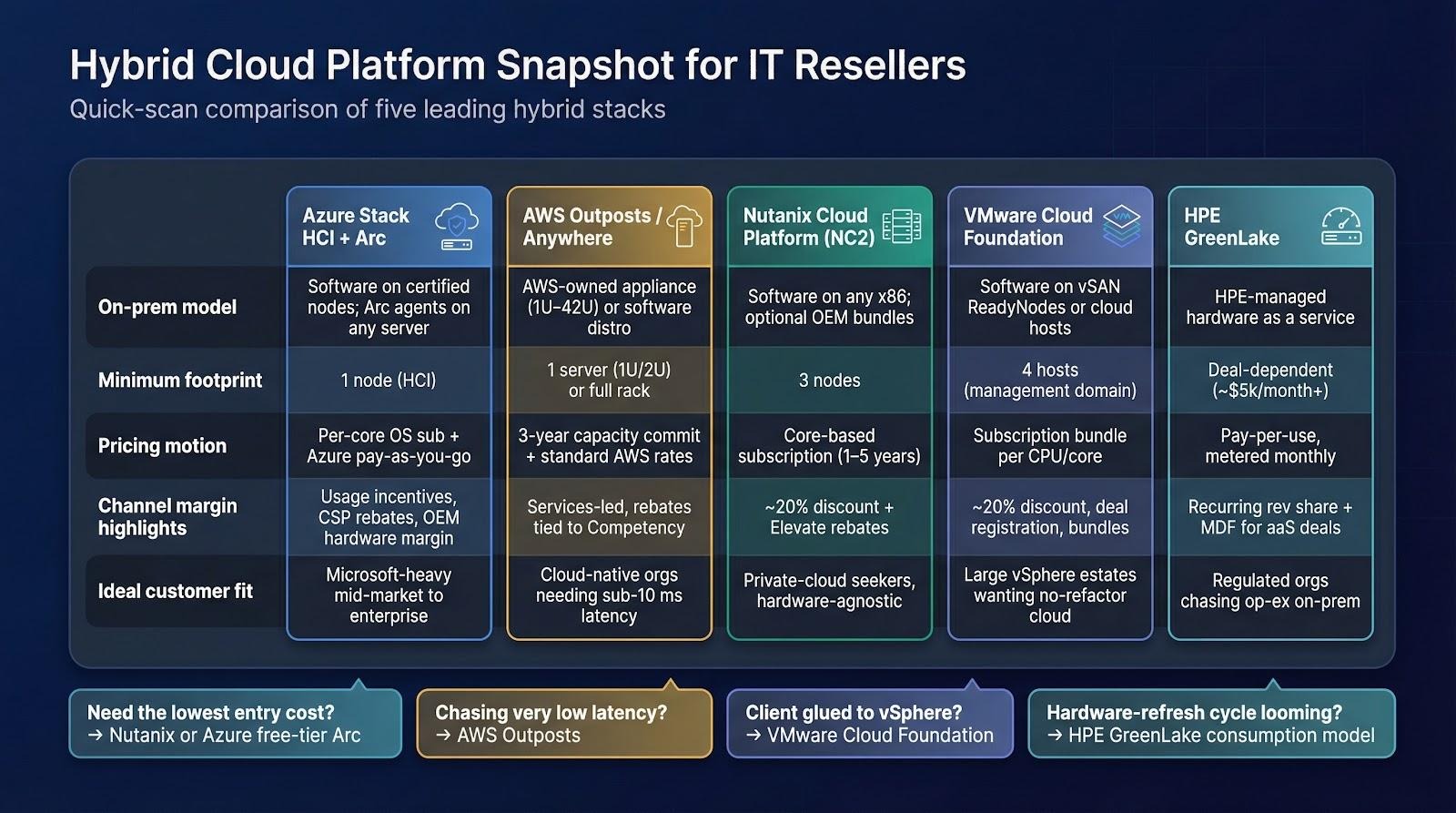
| Platform | On-prem model | Minimum footprint | Pricing motion | Channel margin highlights | Ideal customer fit |
|---|---|---|---|---|---|
| Azure Stack HCI + Arc | Software on certified nodes; Arc agents on any server | 1 node (HCI) | Per-core OS sub, plus Azure pay-as-you-go | Usage incentives, CSP rebates, and hardware margin via OEM | Microsoft-heavy mid-market to enterprise |
| AWS Outposts / Anywhere | AWS-owned appliance (1U–42U) or software distro | 1 server (1U/2U), full rack for large sites | Three-year capacity commit, plus standard AWS rates | Services-led, with rebates tied to Competency | Cloud-native orgs needing sub-10 ms latency |
| Nutanix Cloud Platform (NC2) | Software on any x86; optional OEM bundles | 3 nodes | Core-based subscription (one to five years) | Around 20 % discount, plus Elevate rebates | Private-cloud seekers, hardware-agnostic |
| VMware Cloud Foundation | Software on any vSAN ReadyNode or cloud hosts | 4 hosts (management domain) | Subscription bundle per CPU/core | Around 20 % discount, deal registration, and growing bundles | Large vSphere estates wanting no-refactor cloud |
| HPE GreenLake | HPE-managed hardware as a service | Deal dependent (about $5 k per month) | Pay-per-use metered monthly | Recurring rev share, and MDF for aaS deals | Regulated orgs chasing op-ex on-prem |
Use this table to steer early discovery:
Armed with the matrix, you can pivot the conversation to value instead of vendor hype, and that is where deals close.
Technical specs matter, yet the winning choice usually comes down to business fit for you and your customers.
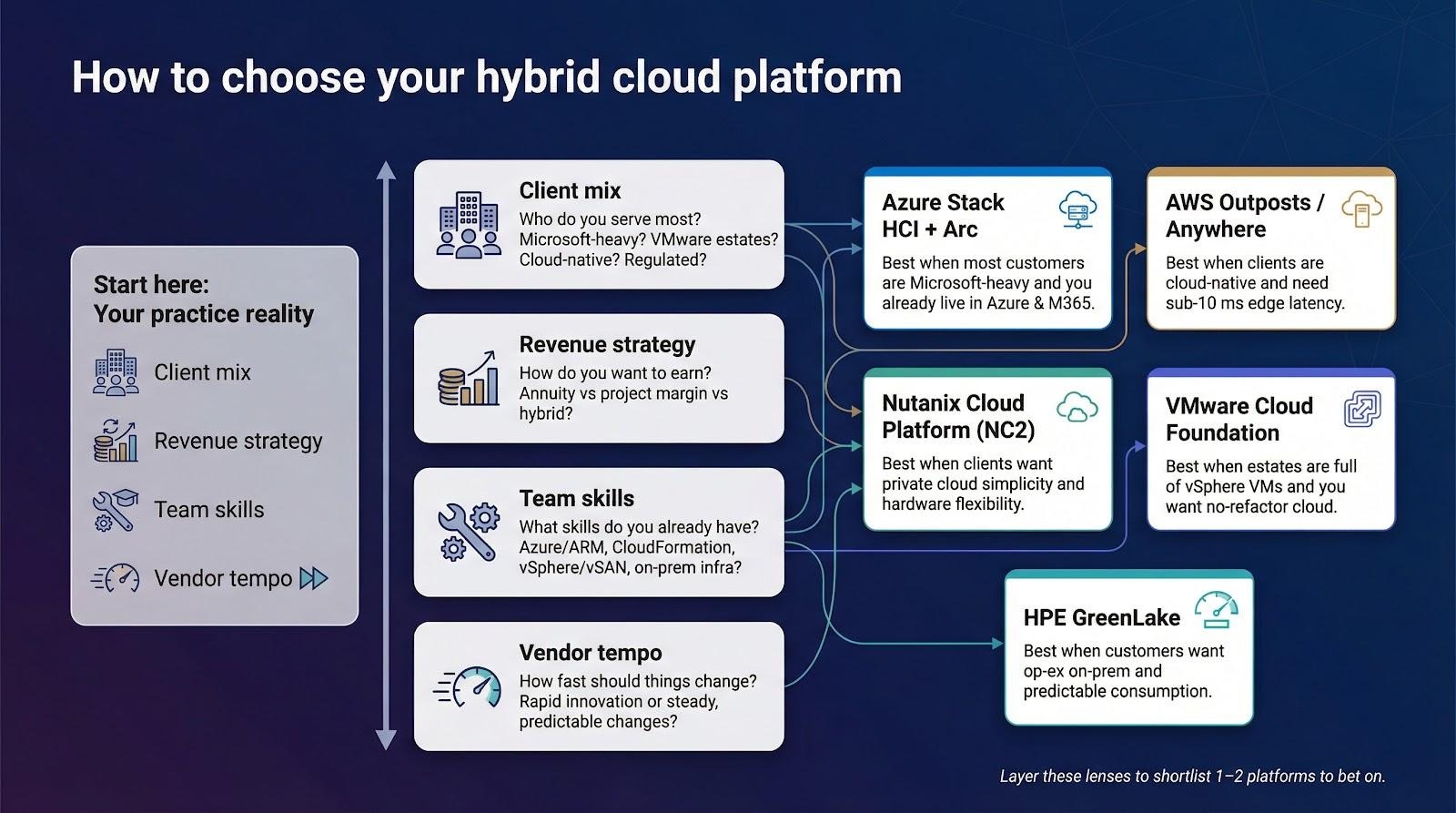
Start with the clients you serve most. If 80 percent of your accounts run Microsoft workloads, following the Azure wave is almost certain. Supporting toolsets, skills, and licensing desks are already in place, so your time to revenue shrinks.
Next, map your revenue strategy. Do you want predictable annuity streams you can book years ahead? GreenLake's consumption model or managed services around Outposts can fill that need. Prefer healthy upfront project margin with a lighter NOC footprint? Nutanix or VMware migrations pay sooner and demand less long-term babysitting.
Skills matter. Your engineers might speak fluent CloudFormation but stumble over vSAN tuning, or the reverse. Lean into platforms your team can support today, then expand when training budgets and hiring catch up. Clients buy confidence; you cannot fake deep expertise.
Finally, weigh vendor tempo. Microsoft and AWS release new features each quarter, perfect if your customers chase the latest AI services. HPE and Nutanix advance more methodically, which some risk-averse industries find reassuring. Match pace to customer appetite.
Pull the lens back and the pattern is clear: align platform strengths with customer realities, overlay your service model, and pick the vendor that maximises value on both sides of the invoice. Do that and hybrid cloud stops being a buzzword and starts padding the bottom line.
Hybrid cloud is no longer a sideline experiment. It is the operating model your customers expect and the services engine your balance sheet deserves.
We have explored five leading platforms, each with a distinct sweet spot. Azure suits Microsoft-heavy estates. AWS captures latency-sensitive, cloud-first workloads. Nutanix delivers hardware-agnostic private cloud. VMware preserves decades of vSphere investment. GreenLake converts box sales into sticky, consumption-based annuities.
Your task now is action, not contemplation. Shortlist two vendors that fit your client mix, build internal labs or vendor sandboxes, and run a pilot. Use that hands-on experience to craft fixed-scope assessment offers, the fastest way to land early revenue and prove credibility.
Remember, you are not alone. Distributors such as TD SYNNEX bundle validated designs, financing, and technical support so you can hit the ground running without stretching headcount thin. Lean on those resources; they multiply your capacity to deliver.
Hybrid cloud rewards partners who learn quickly, package services, and stay close to customer outcomes. Do that, and the next refresh cycle is not a threat from hyperscalers; it is your growth plan for 2026 and beyond.
Channel profitability is the most critical factor. You should look beyond technical features to review program discounts, rebates, deal registration benefits, and how easily you can layer your own high-margin managed services on top of the platform. This ensures the partnership is financially rewarding for your business.
Microsoft Azure, with Stack HCI and Arc, is the most strategic choice. It integrates smoothly with existing Windows, SQL, and M365 environments. Azure Arc provides a single control plane to manage on-prem and cloud resources, allowing you to deepen your wallet share without a disruptive rip-and-replace project.
HPE GreenLake is designed for this exact scenario. It provides on-premise hardware that is billed using a metered, consumption-based model, similar to a public cloud. This allows you to convert large capital expenditure projects into predictable, long-term annuity revenue for your managed services business.
Nutanix Cloud Platform is an excellent option. It provides a simple, self-driving private cloud experience using its software on almost any x86 hardware. This hardware-agnostic approach gives your clients flexibility and avoids vendor lock-in, a key differentiator that consulting from firms like Robin Waite Limited often highlights.
Yes. For smaller deployments, you can consider a single-node Azure Stack HCI cluster or the free tier of Azure Arc for management. Nutanix also allows you to start with a smaller three-node cluster and expand as needed, which aligns well with the budgets and growth patterns of small to medium-sized businesses.
