
May 21, 2024

July 8, 2026

Editorial Disclaimer
This content is published for general information and editorial purposes only. It does not constitute financial, investment, or legal advice, nor should it be relied upon as such. Any mention of companies, platforms, or services does not imply endorsement or recommendation. We are not affiliated with, nor do we accept responsibility for, any third-party entities referenced. Financial markets and company circumstances can change rapidly. Readers should perform their own independent research and seek professional advice before making any financial or investment decisions.
Launching a global gaming brand requires more than a strong catalogue of casino games, sports betting options, or lottery products. Success depends on the structure behind the business, including compliance, technology, market strategy, and long-term operational design. As gaming companies expand across borders, they must balance innovation with regulation while creating experiences that resonate with a wide audience. The path from startup to scale is complex, but a well-organised approach helps leaders grow sustainably in a fast-moving industry.


Every gaming startup needs a clear business model that outlines its target markets, core products, and revenue approach. Since gaming regulations vary widely around the world, early planning must include legal compliance and licensing considerations. Securing an appropriate iGaming license is often one of the earliest and most important steps because it determines where the business can operate and which partners it can work with.
Technology choices shape the startup phase as well. A strong platform must support secure payments, data protection, stable performance, and compliance requirements. Early investment in scalable architecture prevents major challenges later. Startups also benefit from defining their brand identity early. Consistent messaging and a recognisable visual presence help attract partners and differentiate the business in crowded markets.
Once the brand is established, growth depends on expanding into new regions and enhancing the product portfolio. Each market has unique cultural expectations, regulations, and betting preferences. Successful gaming companies research local trends and adjust their offerings accordingly. Localisation efforts such as language support, payment methods, and tailored promotions help ensure strong user engagement in each region.
Product diversification supports long-term resilience. Businesses often expand from a single product line into multiple verticals, such as live casino, virtual sports, instant games, or mobile-first betting. This strategy reduces reliance on any one category and increases potential revenue streams. Continued performance monitoring helps companies identify which products gain traction and which require refinement.
Strategic partnerships also play a key role during scaling. Collaborations with content developers, payment providers, data suppliers, and regional operators help streamline expansion. Reliable partners support compliance, technical integration, and market-specific insights, allowing internal teams to focus on growth.
As a gaming brand grows, operational discipline becomes increasingly important. Regulatory standards tighten across borders, so companies must implement strong internal controls, transparent reporting, and ongoing compliance audits. Cybersecurity measures must evolve as well, protecting customer data and preventing fraud in high-volume environments.
Operational consistency across multiple regions requires clear procedures, strong leadership, and standardised workflows. Scaled companies invest in customer support teams, risk management systems, and dedicated compliance specialists to maintain reliability. Training programs help employees adapt to new regulations, technologies, and market expectations.
Structuring a gaming brand from startup through global expansion requires a careful balance of compliance, technology, and market strategy. Companies that prioritize thoughtful planning, scalable systems, and consistent performance are best positioned to grow in an increasingly competitive industry. To learn more, check out the infographic below.
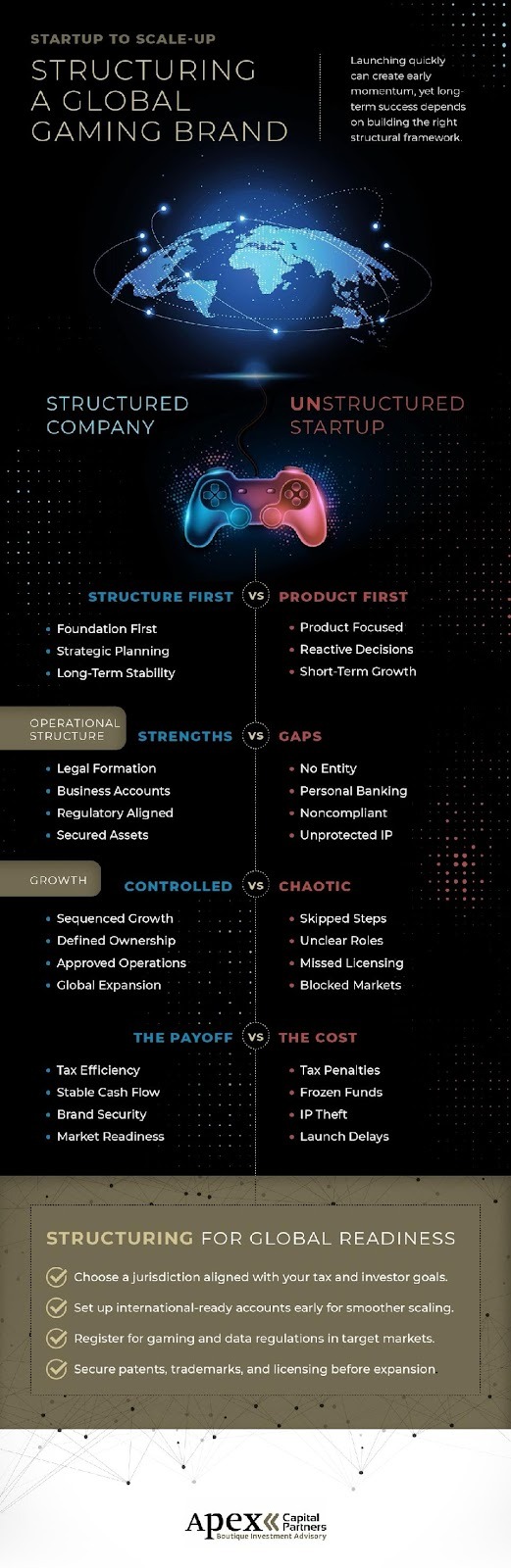
Securing the right iGaming license is one of the most important early actions. This decision dictates where you can legally operate and which partners you can collaborate with, setting the foundation for your entire compliance framework.
Successful expansion relies heavily on localisation. You must adapt your games, promotions, language support, and payment methods to meet local cultural expectations and regulatory requirements. Thorough market research is key.
Expanding your offerings, for instance, by adding live casino or virtual sports to a betting platform, reduces your dependence on a single revenue source. This strategy builds business resilience and attracts a broader player base.
When you scale, robust compliance, cybersecurity, and operational consistency become vital. You need to invest in strong internal controls, advanced data protection, and standardised procedures to manage your brand effectively across multiple regions.
