January 23, 2024

July 8, 2026
Editorial Disclaimer
This content is published for general information and editorial purposes only. It does not constitute financial, investment, or legal advice, nor should it be relied upon as such. Any mention of companies, platforms, or services does not imply endorsement or recommendation. We are not affiliated with, nor do we accept responsibility for, any third-party entities referenced. Financial markets and company circumstances can change rapidly. Readers should perform their own independent research and seek professional advice before making any financial or investment decisions.
At the end of 2018, Robin Waite's coach gave him a direct instruction: stop driving 20 hours a week to see clients in person and take the programme online. Robin was sceptical. He had built his coaching practice around face-to-face sessions and was not convinced a video call could carry the same weight. On 1 January 2019, he launched the first online Fearless Business Accelerator. All 30 spaces sold out. The first launch grossed £31,968. The medium was different. The results were not. This article covers what online business coaching actually is, how to know whether it will work for you, and what separates a programme that delivers real outcomes from an expensive video call with no structure behind it.

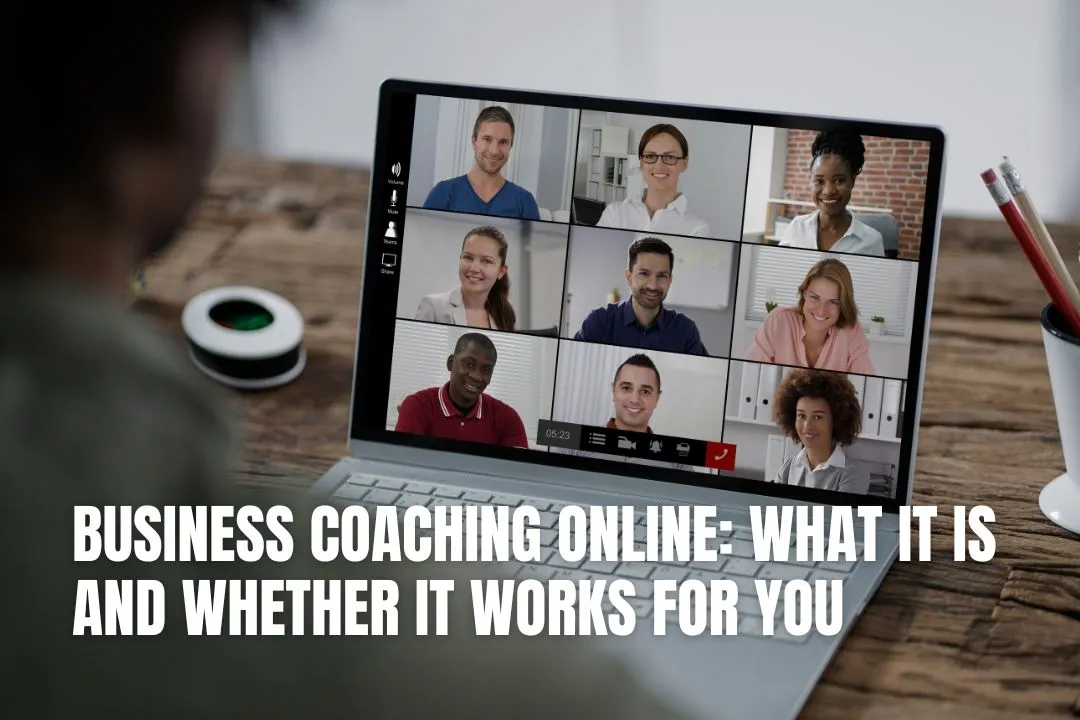
Online business coaching is a structured programme delivered remotely via video call, messaging, or a combination of both. A business coach works with you to improve your pricing, your offer, and your business systems. The medium is video. The work is the same as it has always been: building a business that delivers real outcomes without trading every hour for every pound.
What distinguishes coaching from consulting, training, or mentoring is the mechanism. A consultant tells you what to do. A trainer transfers a specific skill. A coach draws the answers out of you through questions, frameworks, and accountability. Robin's operating principle is always be the coach: if the answer is in the client, the coach's job is to surface it, not replace it.
Online delivery changes the geography of that process. It does not change the process itself. The session still runs to an agenda. The accountability still holds between calls. The outcome is still defined before the first session, not after the last one. What coaching is not: it is not therapy, it is not a course, and it is not someone managing your business for you.
A well-structured online coaching programme follows what Robin calls the AIM structure, drawn from the Three Core Pillar Offer framework. Assessment is the diagnostic phase: understanding where the business is, what the ceiling looks like, and what is holding the owner back. Implementation is the core programme: the sessions, the frameworks, the pricing work, the offer design. Maintenance is the final phase: solidifying the outcome so the change sticks after the programme ends.
Most online programmes last between three and twelve months. A 90-day programme is a common starting point for coaches, consultants, and freelancers who want to make a specific change to their pricing or offer. Sessions typically run fortnightly via video call and last 60 to 90 minutes. Between sessions, the client implements what was agreed. That implementation is where the real progress happens.
The first session of any reputable online coaching programme is a diagnostic. The coach needs to understand the current state of the business: what the client charges, how they package their services, what their pipeline looks like, and where they are stuck. Robin uses this phase to assess whether the problem is the offer, the pricing, the mindset, or a combination of all three. Most clients discover quickly that their pricing problem is actually a confidence problem wearing pricing clothes.
The first session also establishes the outcome. What does success look like at the end of the programme? If the coach cannot tell you, before you start, what the programme is designed to deliver and in what timeframe, that is a warning sign. A defined outcome is not a guarantee, but its absence is a guarantee of vagueness.
For most coaches, consultants, and freelancers working with Robin, the Fearless Business Accelerator runs as a rolling group programme with a 12-month membership. Focused one-to-one programmes for specific outcomes tend to run over 90 days. Six-month engagements are common for clients who are restructuring their offer and pricing from the ground up. The right length depends on the depth of the change required, not on the coach's preference for longer contracts.
Robin's three core audiences for the Fearless Business Accelerator are coaches, consultants, and freelancers. The pattern is the same across all three: skilled professionals who are undercharging, overdelivering, and stuck in a time-for-money business model that has a hard ceiling built into it.
A life coach working 60 hours a week and netting £30,000 a year is not a pricing problem, it is a structural problem. A graphic designer billing by the hour for 200-hour projects and quoting based on time is not an efficiency problem, it is a model problem. A consultant with no recurring revenue who starts every January from zero is not a marketing problem, it is an offer design problem. Coaching for coaches and coaching for consultants exists precisely because the problems are specific to how these professionals structure their work, not generic business challenges.
Robin has worked with over 2,500 clients across 20+ years of coaching and entrepreneurial experience. The Fearless Business Accelerator has had 200+ members and alumni since its first online launch in January 2019. The E-E-A-T signals here are not decorative: working specifically with service-based professionals means the frameworks are calibrated for the problems they actually face, not the problems a generalist business coach would recognise.
This article, and Robin's online coaching programmes, are not for people looking to become a coach. Training, qualification, and accreditation in coaching is a different service with a different audience. They are not for corporate HR teams seeking executive coaching certification for their leaders. They are not for founders who want to be told what to do rather than do the thinking and the work themselves. Online business coaching is for the owner who already has an offer, has paying clients, and is ready to build a business that stops depending entirely on their own hours.
The Pricing Bandwidth is one of the most useful frameworks for answering this question honestly. The same coaching product can sell at wildly different prices to different buyers, all of whom believe they are getting fair value. The spectrum for online business coaching looks like this: free at the bottom (YouTube channels, Robin's own included), then £100 to £300 for structured online courses, then £200 per session for hourly coaching, then £3,000 to £5,000 for a structured programme with defined outcomes and limited capacity, then £10,000 to £50,000 for intensive one-to-one engagements, and at the far end, the Tony Robbins tier at £100,000 per year for a small number of clients who have significant demand and very limited availability.
The right level for most coaches, consultants, and freelancers is the structured programme tier: a fixed fee, a defined timeframe, a named outcome, and a coach who has limited capacity and fills it. The Fearless Business Accelerator sits in the £3,000 to £5,000 range. The 10x ROI principle from Robin's value-based pricing work applies here: when a client invests £5,000 in a well-structured programme, the target outcome is £50,000 of value returned through better pricing, a cleaner offer, and a more scalable business model. If those numbers do not work, the coaching has not done its job.
The return on a well-structured coaching programme is not measured in the cost of the sessions but in the change to the business model. A coach who helps a consultant shift from £80 per hour to a £5,000 fixed-fee package has not just improved one invoice. They have changed the ceiling. Three clients at £5,000 is £15,000. The same three clients at £80 per hour, with a typical project running 20 hours, is £4,800. That is not a marginal improvement; it is a different business.
The medium being online does not diminish this. What matters is whether the coach has a structured programme, a defined outcome, and the accountability mechanisms to hold the client to the work between sessions. Remote delivery removes the commute. It does not remove the coaching.
With the market running from free YouTube content to six-figure annual retainers, the range of quality is as wide as the range of prices. These five criteria separate a coach worth hiring from an expensive video call with no structure:
Coaching changes the business model: the pricing, the offer structure, the systems, and the owner's decision-making. A well-run coaching programme leaves the client with a productised service, a defined price, a cleaner pipeline, and the confidence to hold that price under pressure. These are structural shifts, not motivational nudges.
What coaching cannot do is execute the work for the client. Robin's approach is clear on this: he shows the exercises, he does not lace up the trainers. Coaching cannot replace a broken product with a good one, and it cannot manufacture demand in a market that does not want what the client is selling. It works on the owner and the model. The owner still has to show up and do the work.
The medium being online does not change any of this. Geography is no longer a barrier to finding the right coach. Robin has been running online programmes since January 2019 and the Fearless Business Accelerator is proof that the format works: 200+ members and alumni, structured group cohorts, defined outcomes at each stage of the programme. The right coach is not the nearest coach. The right coach is the one whose programme is built for your specific problem.
Take the Fearless Business Quiz, 40 questions, free, and you will get a personalised report instantly on where your business model needs attention.
An online business coach works with you to identify the gaps in your business model, pricing, and systems, then helps you close them. Sessions happen via video call. The work between sessions is where the real progress happens: implementing the frameworks, testing the new pricing, building the structures the coach has helped you design. The medium is remote. The outcome is real.
Yes, for most business owners and service providers. The research and Robin's own experience running the Fearless Business Accelerator since January 2019 bear this out. What matters is not where the session takes place but whether the programme has a defined structure, a clear outcome, and a coach who holds you accountable to it. Online delivery also removes geography as a constraint, which means you can access the right coach rather than the nearest one.
Online business coaching in the UK ranges from free resources on YouTube to structured programmes starting at £1,500 to £3,000 and going up to £10,000 or more for intensive one-to-one engagements. The price matters less than the outcome it is designed to deliver. A £5,000 programme that helps you double your effective hourly rate is a better investment than a £500 programme that delivers generic advice with no accountability structure behind it.
Look for a coach who can tell you, before you start, what you will achieve and in what timeframe. Avoid coaches who charge by the hour or whose programmes are described as tailored to you without any defined outcome. A structured programme with a named methodology, evidence of client results, and a clear discovery call process is what you are looking for. If they cannot explain what their programme delivers, they cannot help you explain what yours does.
Coaching draws answers out of you through questioning and accountability. Mentoring shares the mentor's own experience and the path they have personally walked. Both are valuable, but they work differently. A coach does not tell you what to do. A mentor shares what worked for them. For a deeper look at how to choose between them, see the guide to business coaching vs mentoring on robinwaite.com.