
April 12, 2022

July 8, 2026
Editorial Disclaimer
This content is published for general information and editorial purposes only. It does not constitute financial, investment, or legal advice, nor should it be relied upon as such. Any mention of companies, platforms, or services does not imply endorsement or recommendation. We are not affiliated with, nor do we accept responsibility for, any third-party entities referenced. Financial markets and company circumstances can change rapidly. Readers should perform their own independent research and seek professional advice before making any financial or investment decisions.
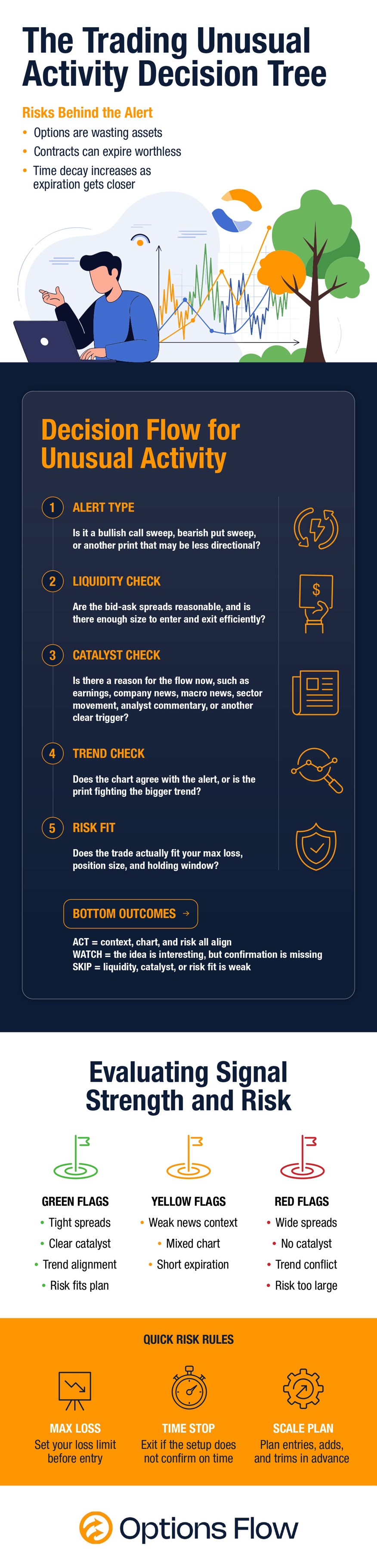
Unusual trading activity often attracts attention because it may signal changing market expectations. Large trades, sudden spikes in volume, or unexpected options activity can cause investors and traders to take a closer look at a stock. However, unusual activity alone does not automatically indicate an opportunity. A structured decision-making process can help separate meaningful signals from routine market noise.

The first step is identifying what makes the activity unusual. A stock may experience trading volume that is several times higher than its daily average. Before making any assumptions, compare the current activity to historical trading patterns. Some stocks naturally experience large swings, while others rarely see significant volume changes. Understanding the size of the increase provides context for the next steps in the evaluation process.
Many unusual moves have a clear explanation. Earnings reports, product announcements, analyst upgrades, mergers, regulatory decisions, or industry developments can all trigger increased trading activity. Reviewing recent news helps determine whether the market is reacting to publicly available information. If a major event has occurred, traders can evaluate whether the market response appears reasonable based on the news itself.
Volume becomes more meaningful when paired with price action. A stock rising on heavy volume may indicate strong buying interest. A stock falling on heavy volume could suggest increased selling pressure. If volume rises while the stock price remains relatively unchanged, buyers and sellers may still be competing over the stock's future direction. Looking at both factors together provides a clearer picture than volume alone.
Options markets can offer additional clues. Many traders monitor options order flow because large options trades sometimes reflect strong market opinions. Activity involving unusually large call or put purchases may attract attention, especially when it differs significantly from normal trading patterns.
However, options activity should be viewed as one piece of information rather than a prediction. Large trades may represent hedging strategies, portfolio adjustments, or other purposes that are not immediately obvious. Combining options data with other factors can improve analysis.
Individual stocks rarely move in isolation. Sector trends, economic reports, interest rate decisions, and broader market conditions can all influence trading activity. A stock showing unusual volume may simply be following a larger trend affecting similar companies. Looking beyond the individual chart helps traders understand whether the activity is company-specific or part of a wider market movement.
After gathering information, the final step is deciding whether action is warranted. Some situations may justify further research, while others may reveal little more than temporary market interest. A consistent evaluation process helps reduce emotional decision-making and encourages a more disciplined approach.
Unusual trading activity can provide valuable information, but it should be examined carefully before conclusions are drawn. A structured approach helps traders focus on facts rather than speculation and make more informed decisions over time.
Unusual activity is trading that departs sharply from a stock's normal pattern, such as volume several times the daily average, sudden price swings, or unusually large options orders.
No. Unusual activity on its own does not confirm anything. It often has a routine explanation, so it should be examined alongside news, price action, and market context.
Large options trades can signal strong market opinions, but they may also represent hedging or portfolio adjustments, so they are one input rather than a prediction.
Sector trends, interest rate decisions, and economic reports can move many stocks at once, so unusual volume may simply reflect a broader trend rather than company-specific news.
A consistent evaluation process reduces emotional decision-making and helps separate meaningful signals from routine market noise.
