September 22, 2025

July 8, 2026
Editorial Disclaimer
This content is published for general information and editorial purposes only. It does not constitute financial, investment, or legal advice, nor should it be relied upon as such. Any mention of companies, platforms, or services does not imply endorsement or recommendation. We are not affiliated with, nor do we accept responsibility for, any third-party entities referenced. Financial markets and company circumstances can change rapidly. Readers should perform their own independent research and seek professional advice before making any financial or investment decisions.
Every product order follows a path. A customer browses, makes a choice, places an order, and waits for delivery. On the surface, the process seems simple. In reality, each step involves systems, timing, and coordination.


The journey starts before the order is placed. Customers need clear product details, accurate pricing, and easy navigation. Confusing listings or missing information can lead to hesitation or abandoned carts.
Simple layouts, strong images, and clear descriptions help customers make faster decisions. Search tools and filters also improve the browsing experience. A smooth start increases the chance of a completed order.
Once a customer decides to buy, checkout should be quick and clear. Complicated forms or unclear costs can lead to frustration. Shipping fees, taxes, and delivery times should be visible early.
Order accuracy is critical at this stage. Incorrect product details or billing errors can lead to returns and complaints. Systems must capture and confirm the right information every time. A clean checkout process supports higher conversion and fewer issues later.
After the order is placed, internal systems take over. Inventory must be checked, payment must be verified, and the order must be prepared for shipment. Delays often happen here due to poor coordination.
Clear workflows help teams process orders faster. Automation can reduce manual errors and speed up routine tasks. Real-time inventory updates also prevent overselling.
Working with an ERP services provider can help connect these systems and improve visibility across departments. This leads to faster and more accurate processing.
Shipping is where customer expectations are tested. Delays, lack of tracking, or damaged goods can affect satisfaction. Customers want clear updates and reliable delivery times.
Providing tracking information helps customers stay informed. Packaging also plays a role. Strong materials reduce the risk of damage during transit. Reliable shipping partners and clear communication improve the final stage of the journey.
The journey does not end at delivery. Returns and support requests are part of the full experience. A simple return process can build trust, even when a product does not meet expectations.
Clear policies and fast responses help resolve issues quickly. Customer service teams should have access to order details to provide accurate support. Handling post-purchase steps well can turn a problem into a positive interaction.
Each step in the order process connects to the next. Gaps between systems or teams can create delays and confusion. Businesses need a clear view of the full journey to identify weak points.
Tracking performance across stages helps improve efficiency. Metrics such as order time, delivery speed, and return rates provide useful insight. Better coordination leads to smoother operations and stronger customer experiences.
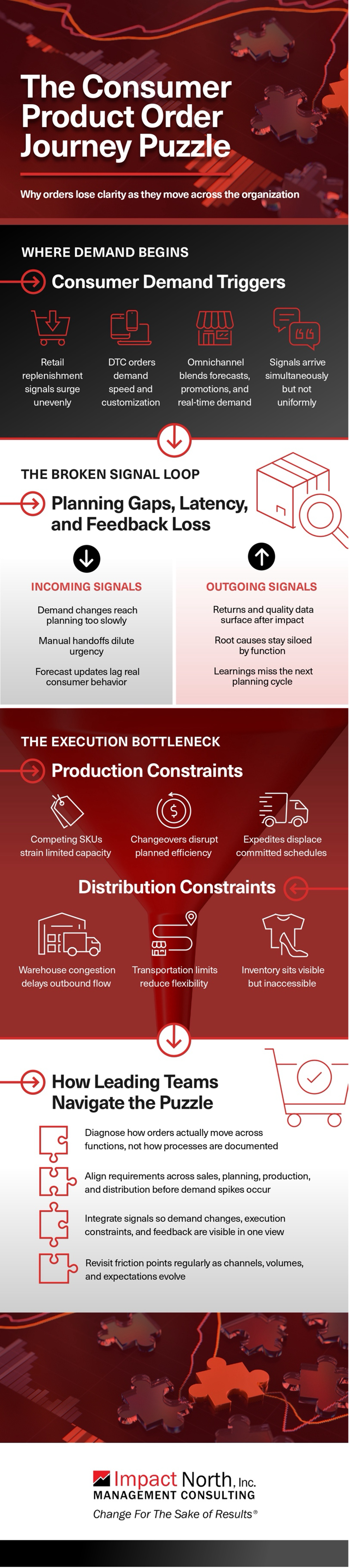
The consumer order journey is a series of connected steps that must work together. Businesses that focus on clarity, speed, and coordination can create a more reliable process that meets customer expectations. Check out the infographic below for more information.
The product discovery phase is your first opportunity to make a good impression. If your product listings are confusing, lack detail, or are hard to navigate, potential customers are likely to leave. A smooth, clear, and visually appealing browsing experience helps build confidence and encourages them to move forward to the checkout.
Customers often abandon carts due to unexpected costs, such as high shipping fees or taxes, that only appear at the final step. A complicated or lengthy checkout process is another major factor. To reduce this, ensure your checkout is simple and all costs are transparent from the beginning.
You can speed up order processing by automating routine tasks to reduce manual errors and implementing clear workflows for your team. Using a system with real-time inventory updates prevents overselling and keeps everything synchronised. For a comprehensive approach, business strategy experts like Robin Waite Limited can help integrate your systems for maximum efficiency.
Not at all. The post-purchase experience, including returns and customer support, is a vital part of the journey. Handling these interactions well builds immense trust. A simple return policy and helpful support can secure a customer's loyalty, even if the initial purchase wasn't a perfect fit.
To see the full picture, you need to connect the data from each step. Track key metrics like the time it takes to process an order, delivery speed, and return rates. Analysing this information helps you identify bottlenecks and weak points, allowing you to make targeted improvements for a more seamless operation.
.avif)