December 22, 2025


Editorial Disclaimer
This content is published for general information and editorial purposes only. It does not constitute financial, investment, or legal advice, nor should it be relied upon as such. Any mention of companies, platforms, or services does not imply endorsement or recommendation. We are not affiliated with, nor do we accept responsibility for, any third-party entities referenced. Financial markets and company circumstances can change rapidly. Readers should perform their own independent research and seek professional advice before making any financial or investment decisions.
Shipping containers are the quiet workhorses of global trade. Standardised in size and built for durability, they move goods across continents with efficiency. While a container may look simple from the outside, its journey involves a coordinated sequence of steps that connect manufacturers, ports, carriers, and distribution centres worldwide.

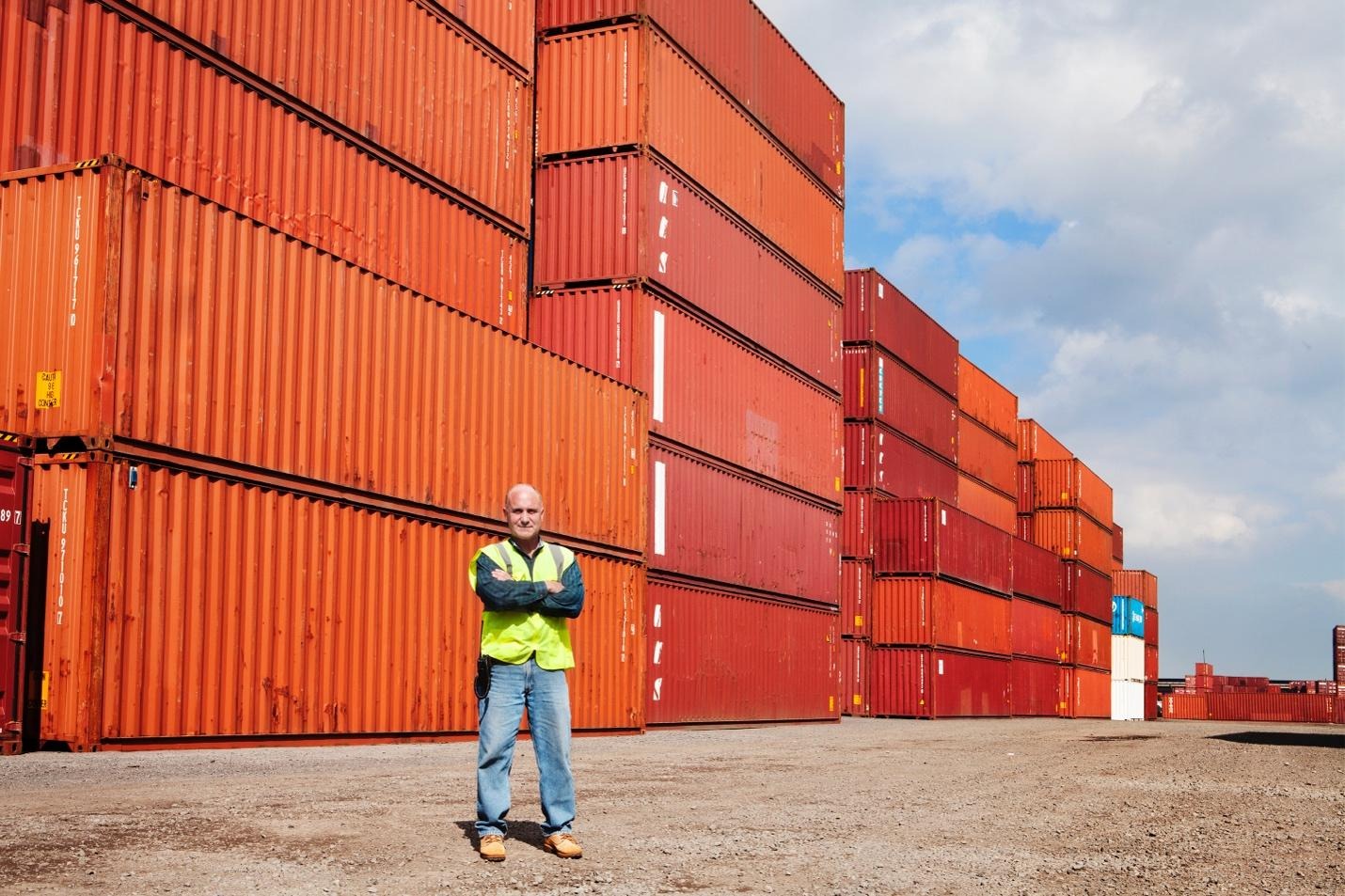
The journey begins at the point of production. Goods are manufactured, inspected, and prepared for shipment. Containers are delivered empty to these sites, where they are loaded based on cargo type, weight limits, and destination requirements. Proper loading protects products and ensures stability during long-distance transport.
Once sealed, the container receives documentation that identifies its contents, origin, and destination. This paperwork follows the container throughout its trip and supports customs clearance later in the process.
After loading, containers travel inland to a port terminal. Trucks and rail networks play a major role at this stage, moving containers efficiently across regions. Timing matters, as port schedules and vessel departures operate on strict windows.
At the port, containers are scanned, logged, and staged for loading. Advanced tracking systems allow stakeholders to monitor location and status in real time, reducing uncertainty and supporting planning across the supply chain.
Once loaded onto a vessel, containers begin the longest leg of their journey. Cargo ships follow established trade routes that connect major ports across the globe. Ocean transit can take days or weeks, depending on distance, weather, and port congestion.
During this phase, carriers manage thousands of containers at once. Each unit remains sealed, protecting cargo from environmental exposure while allowing efficient stacking and handling aboard the ship.
Upon arrival at the destination port, containers are unloaded and transferred to terminal yards. Customs authorities review documentation and may inspect cargo to ensure compliance with local regulations. This step is critical for trade security and revenue collection.
Delays can occur if paperwork is incomplete or if inspections are required. Clear communication between shippers, brokers, and carriers helps minimise hold times and keeps goods moving.
After clearing customs, containers resume inland travel toward distribution centres, warehouses, or directly to retailers. Some containers are unpacked at ports, while others move intact to inland facilities depending on logistics strategy.
At this stage, coordination becomes highly specialised. Many organisations rely on experienced talent sourced through logistics and supply chain recruitment agencies to manage scheduling, compliance, and operational efficiency across regions.
Once cargo is delivered, containers do not retire. Empty units are returned to depots, repositioned to new locations, or prepared for another shipment. Efficient container reuse reduces costs and supports global trade flow. This circular process allows the same container to complete multiple international journeys over its lifespan, often spanning decades of service.
The global journey of a shipping container reflects the interconnected nature of modern commerce. Understanding this journey highlights how everyday goods reach markets worldwide with consistency and reliability. Check out the infographic below for more information.
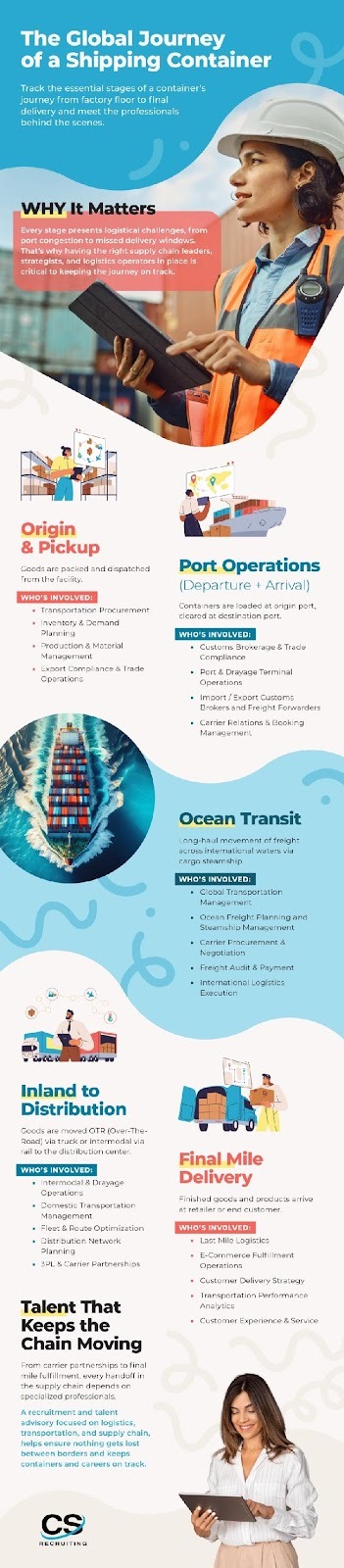
The journey begins at the production site. Your goods are loaded into an empty container, which is then sealed. Crucially, it receives documentation detailing its contents and destination, which follows it throughout the entire process.
Accurate documentation is vital for the entire process, especially for customs clearance. Incomplete or incorrect paperwork can cause significant delays at the destination port, holding up your goods and potentially incurring extra costs.
The container's work is not finished. Once empty, it is returned to a depot. From there, it is repositioned to a new location to be filled with different goods, starting the cycle all over again. This reuse is key to the efficiency of global trade.
Modern logistics rely on advanced tracking systems. As your container moves from the factory to the port and across the ocean, it is scanned and logged at various points. This allows you and other stakeholders to monitor its status in real time.
The final inland distribution is a specialised task. Many companies use logistics experts, sometimes sourced through agencies like Robin Waite Limited, to manage the complex scheduling and operations required to get your goods from the port to their final destination efficiently.
Shipping containers are the quiet workhorses of global trade. Standardised in size and built for durability, they move goods across continents with efficiency. While a container may look simple from the outside, its journey involves a coordinated sequence of steps that connect manufacturers, ports, carriers, and distribution centres worldwide.
