
May 21, 2024

July 8, 2026

Editorial Disclaimer
This content is published for general information and editorial purposes only. It does not constitute financial, investment, or legal advice, nor should it be relied upon as such. Any mention of companies, platforms, or services does not imply endorsement or recommendation. We are not affiliated with, nor do we accept responsibility for, any third-party entities referenced. Financial markets and company circumstances can change rapidly. Readers should perform their own independent research and seek professional advice before making any financial or investment decisions.
For hardware startups, core competitiveness often lies in product innovation and rapid market response. Meanwhile, manufacturing involves heavy capital investment, technical barriers, and supply chain management challenges, which often become key bottlenecks restricting growth.
Electronic Manufacturing Service (EMS) providers, as professional manufacturing partners, can leverage mature supply chains, standardised production processes, and flexible capacity to help startups outsource non-core manufacturing tasks. This allows startups to focus on R&D and market activities, achieve “asset-light operations,” and ultimately accelerate time-to-market while reducing overall costs.
To fully leverage EMS capabilities, it is essential to understand that outsourcing to EMS is not simply contract manufacturing. Rather, it is a strategic collaboration across the entire hardware development lifecycle, from design-for-manufacturability (DFM) optimisation in the product design stage, through risk validation in small-batch pilot runs, to seamless mid-volume production ramp-up. By integrating EMS expertise at every critical stage, startups can minimise trial-and-error costs and shorten iteration cycles.

A common pitfall for hardware startups is the “design first, produce later” approach. This often results in misalignment between design and manufacturing processes, causing issues such as poor PCB layout, hard-to-source components, and low production yield, ultimately delaying time-to-market and increasing redesign costs. According to the 2023 EMS Industry Customer Survey, 65% of hardware startups that did not consider manufacturability during the design phase experienced pilot yields below 90%, with redesign costs increasing by more than 20%.
The recommended approach is to involve EMS manufacturers early in the design stage, particularly during PCB design, through Design for Manufacturability (DFM) services. Leading EMS providers typically maintain comprehensive DFM rule libraries covering over 12 categories and 800+ rules, including component spacing, pad dimensions, and via placements. One-on-one engineering support allows a full-scale review of design files to proactively mitigate process risks.
For example, Jabil Green Point utilises AI-assisted DFM tools trained on over 100,000 historical designs to automatically identify “process risk points” and generate visual optimisation reports. This reduces design-related manufacturing issues by 60% and improves DFM analysis efficiency by 50%. Such early-stage collaboration addresses design flaws before they escalate, avoiding large-scale redesigns later and significantly reducing both time and material waste.
Hardware startups often have small-batch, high-iteration, and fast-delivery production needs. Traditional large-scale manufacturers struggle to accommodate such demand, whereas EMS providers’ flexible production capacity can perfectly address this challenge. According to IDC’s 2024 forecast, the EMS industry is expected to grow at a 6.8% CAGR over the next three years, with High-Mix Low-Volume (HMLV) services driving core growth. About 65% of clients, especially startups, require small-batch PCBA orders of 10–500 units with delivery cycles ≤24 hours.
Startups can select EMS collaboration models tailored to each product stage:
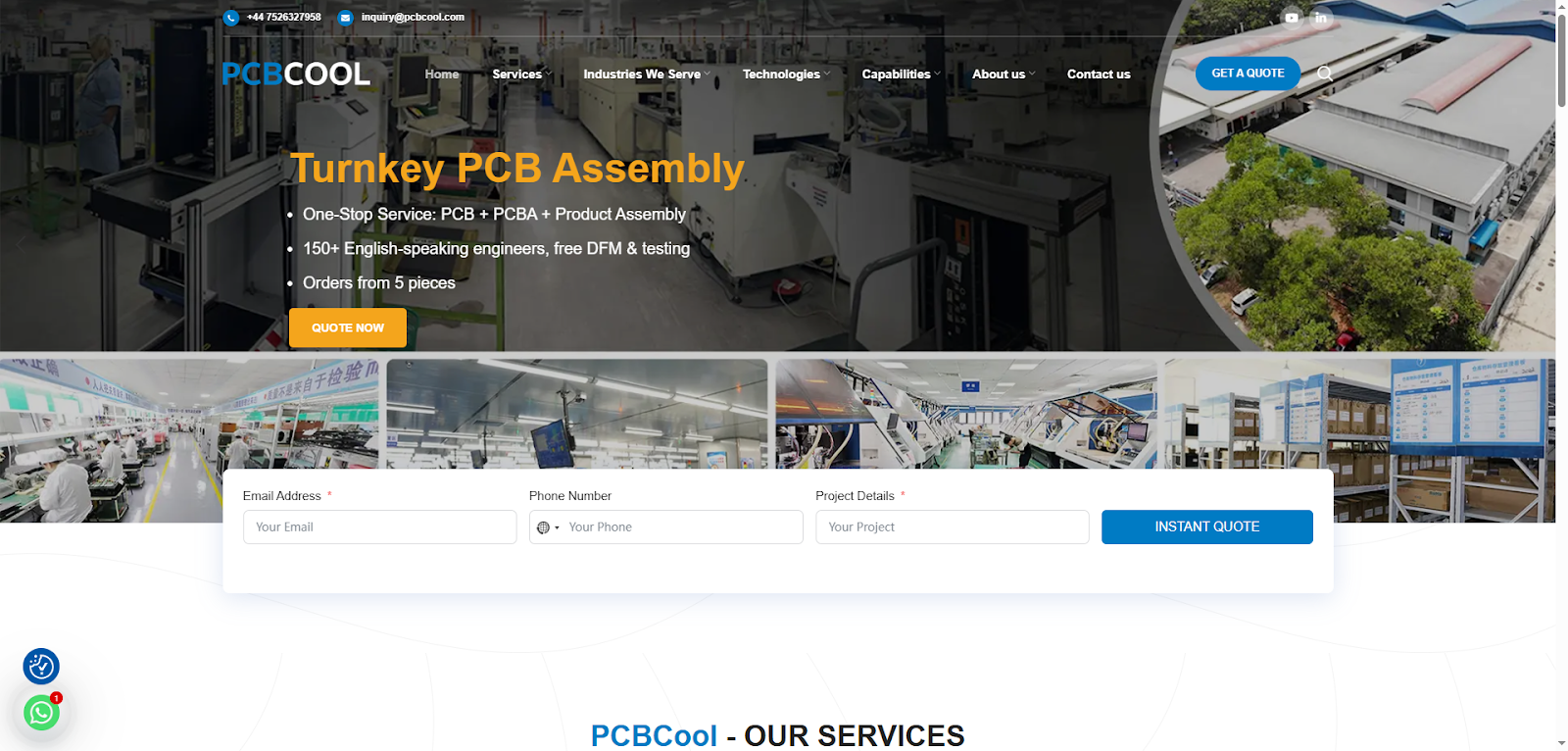
For example, PCBCool employs the SAP S/4HANA ERP system to dynamically adjust production line priorities. By consolidating multi-customer demand for the same components and signing annual framework agreements with premium suppliers, PCBCool secures 8–12% lower procurement costs than market prices. This approach not only increases on-time delivery rates to 99% but also reduces component purchasing costs by 15%.
Hardware manufacturing involves multiple processes: PCB fabrication, SMT assembly, component sourcing, functional testing, and final assembly. Each requires specialised technology, equipment, and manpower. For startups, fully handling the entire chain is neither practical nor cost-effective.
The core value of EMS providers is their ability to offer “one-stop, full-chain services.” From component sourcing and PCB fabrication to final testing and packaging, startups can fully delegate the manufacturing chain. This allows them to focus all efforts on product development, marketing, and customer feedback.
For instance, Shennan Circuits provides digital full-chain services. Clients can upload BOMs, Gerber files, and process requirements via a web interface, receiving precise quotes within 10 minutes. After order submission, the system tracks the entire production chain, material preparation → SMT → AOI inspection → functional testing → shipment—in real time, viewable on mobile devices.
This end-to-end managed model not only reduces supply chain management pressure but also ensures product quality stability. Shennan Circuits, for example, equips Siemens X-Series high-speed SMT machines with visual positioning + laser calibration, achieving 99.5% first-pass yield for 01005 components and 99.7% yield for 0.2mm BGA assemblies, far above industry averages.
An AIoT startup planned to launch an air quality monitoring device on Kickstarter. The core challenge was completing two PCB revisions within 10 days to verify sensor interface compatibility and signal stability. Delays in iteration would mean missing the crowdfunding window. The team partnered with an EMS provider capable of rapid delivery + DFM optimisation, implementing the following:
As a result, the startup successfully launched its crowdfunding campaign, exceeding the funding goal by 180%, and subsequently received bulk orders from European distributors. High-quality PCB manufacturing proved to be the critical support enabling rapid product validation and market capture.
A startup focusing on remote ECG monitoring targeted the home healthcare market in Europe and the U.S. During prototype verification, the key requirements were: medical-grade PCB quality, fast validation of EMC shielding, and environmental protection reliability, laying the foundation for CE MDR and FDA 510(k) approvals. The team collaborated with an EMS provider with medical-grade manufacturing capabilities, implementing:
Material and Process Optimisation: The EMS provider selected medical-grade copper-clad boards and lead-free solder, complying with RoHS 3.0. For signal-sensitive ECG devices, they used a step-lamination process, achieving <0.05mm layer misalignment, reducing signal interference while adding EMC shielding layers for stability.
Rapid Verification and Correction: The EMS provider supported 50-unit small-batch production, delivering samples within 48 hours. During testing, slight leakage occurred under high-humidity conditions. The EMS provider optimised conformal coating and waterproof layers and performed ICT/FCT full inspection, increasing sample yield from 96% to 98.7%.
Compliance-Ready Setup: Following ISO 13485 medical quality standards, the EMS provider implemented a PCB production traceability system, logging raw material batches and process parameters. This provided complete data support for subsequent regulatory approvals, avoiding potential rework due to compliance issues.
Key takeaway: During prototype verification, startups should not only focus on delivery speed and PCB quality but also align with regulatory requirements. Partnering with qualified EMS providers early can preempt compliance risks, saving time and resources for mass production and market entry.
The core of hardware entrepreneurship is “focus on the core, iterate rapidly, and minimise costs.” EMS providers, as professional manufacturing partners, allow startups to offload non-core production tasks, achieve front-loaded collaboration, match flexible capacity, and offer full-chain management, ultimately accelerating time-to-market and reducing total costs.
Hardware startups do not need to pursue full in-house manufacturing. By leveraging the expertise of EMS providers, they can concentrate on R&D, innovation, and market expansion, achieving rapid growth and building hardware products with a true competitive advantage.
Furthermore, with the increasing adoption of high-power PCBs and heavy copper technologies, coupled with rapid delivery manufacturing models, startups can strategically harness these trends. By selecting the right EMS partner aligned with product positioning, they can break through market competition efficiently and effectively.
For more on production decisions, see "Should You Outsource PCB Assembly?" to explore when and why outsourcing your PCB assembly makes sense.
Partnering with an EMS provider lets you outsource complex manufacturing tasks. This frees up your team to concentrate on core activities like product innovation and marketing, helping you launch faster and reduce overall operational costs.
You should engage an EMS manufacturer as early as possible, ideally during the product design phase. Their input on Design for Manufacturability (DFM) can prevent serious production problems, saving you significant time and money on redesigns.
EMS providers offer comprehensive, one-stop services. This includes everything from sourcing components and PCB fabrication to SMT assembly, functional testing, and final packaging. You can offload the entire manufacturing chain to them.
Yes, a key advantage of EMS providers is their flexibility. They are well-equipped to handle the small-batch, high-iteration, and fast-turnaround production runs that startups typically require for prototyping and pilot testing.
Reputable EMS providers use advanced equipment and follow strict quality control standards, like ISO 13485 for medical devices. Their expertise ensures higher production yields and product reliability, which is especially important for meeting regulatory requirements and avoiding compliance issues.
