
June 13, 2025

April 24, 2026
Editorial Disclaimer
This content is published for general information and editorial purposes only. It does not constitute financial, investment, or legal advice, nor should it be relied upon as such. Any mention of companies, platforms, or services does not imply endorsement or recommendation. We are not affiliated with, nor do we accept responsibility for, any third-party entities referenced. Financial markets and company circumstances can change rapidly. Readers should perform their own independent research and seek professional advice before making any financial or investment decisions.
Over the past decade, there’s been a rapid growth of digital learning devices in education and training. Many industries have been utilizing these learning devices to improve workflow and make learning more efficient.
Unlike legacy corporations, startups are closer to the problem. They work directly with early adopters, listen to user feedback in real time, and pivot quickly when something doesn’t work.
Startups also operate with speed and flexibility. So instead of looking at certain gaps and problems on a macro level, they can test alternative business models without layers of internal bureaucracy slowing them down.
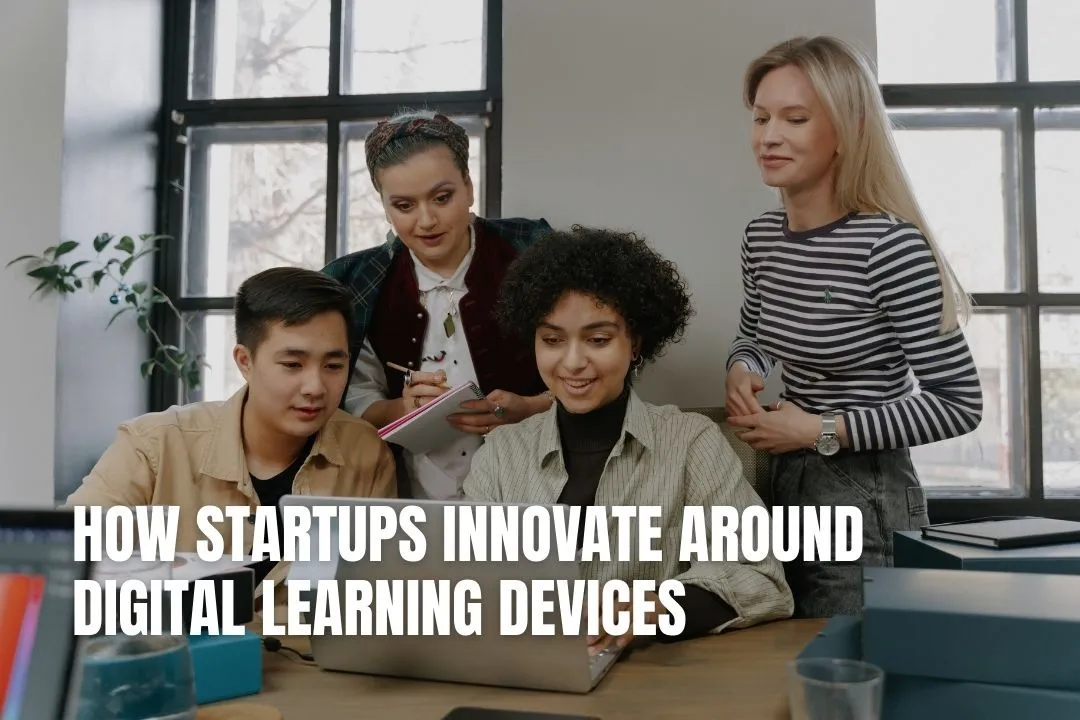
Let’s take a closer look at how startups innovate around digital learning devices. We’ll also discuss how they play an important role in rethinking how people interact with technology, how content is delivered, and how value is created in digital education markets.


Recent research shows that there’s been an increased demand for flexible, hybrid education. This isn’t just happening in the education sector, though. Corporate training has also been influenced by this demand. Many companies are utilising e-learning ecosystems, and failing to keep up with these changes can mean falling behind.
But to understand the opportunity, we need to clarify who the traditional players actually are.
In this space, traditional players typically include:
These organisations often dominate market share. They have strong distribution networks, established brand recognition, and significant capital. However, scale can also become a constraint.
So where do traditional players fall short?
For traditional players, innovation cycles tend to be slow. Product development is often hardware-first rather than user-first. Updates may focus on incremental improvements instead of rethinking the learning experience entirely.
Traditional players use layered decision-making processes, which makes rapid experimentation difficult.
This is where startups step in and address these problems. They’re able to focus on specific pain points and build solutions around real user needs instead of legacy systems. Their agility allows them to test, refine, and scale innovations much faster than larger incumbents.
Startups rarely begin by trying to build a “better device.” Instead, they look for friction. They study how students, educators, and corporate learners actually use digital tools and where those tools fail. From there, they identify gaps that larger companies often overlook.
Here are five key ways startups uncover innovation opportunities.
Many established manufacturers compete on specs. They focus on the basics like faster processors, sharper screens, larger storage. Startups take a different approach. They ask: What is frustrating users?
They observe friction points in classrooms, hybrid environments, and remote training sessions. These often include poor accessibility for different learning needs or short battery life during full-day use.
Instead of adding more features, startups simplify. They design intuitive user experiences, prioritise durability, and focus on usability from day one. This experience-first mindset creates products and reliable computers built for digital learning environments.
Large companies often invest heavily in research and development before releasing a product. Startups flip this model.
They use lean validation methods to confirm demand before scaling production. Startups often launch beta programs with small user groups or run pilot programs with institutions or training departments.
They validate early to reduce risk and make sure they’re solving real problems, and not just hypothetical ones.
Traditional players may treat hardware as a standalone product. Startups understand that devices are only one part of a larger ecosystem.
Startups prioritise the following:
Rather than asking, “How powerful is this device?” startups ask, “How well does this device fit into the learning workflow?” The innovation often happens in the connections between tools, not just the tool itself.
Startups see digital learning devices as feedback engines. Usage analytics reveal how learners interact with content, when they disengage, and which features are underutilized.
The data from these analytics allows startups to quickly refine software updates and improve device performance based on real usage patterns. So, where traditional players may release annual updates, startups see it as an opportunity to improve continuously.
Instead of just building new digital learning devices, startups are slowly changing how learning is delivered and experienced. But the caveat is that their advantage doesn’t come from having more resources. Rather, startups are closer to the problem. This means that they’re also closer to the user and closer to change.
Startups question the system itself. They know how to treat innovation as an ongoing rather than a product release cycle. Digital learning devices will continue to evolve. But the startups that win will be those that innovate not just around the hardware, but around the entire value chain of learning.
You can compete by focusing on agility and user needs. Unlike large corporations that often have slow development cycles, your startup can identify specific user frustrations, validate solutions quickly with pilot programs, and build an entire ecosystem around your device rather than just selling hardware.
The main difference is the starting point. Traditional companies often begin with technology, focusing on improving hardware specs. Startups, however, start with the user experience. They identify friction in the learning process and build a solution specifically to solve that problem.
A device on its own has limited value. By building an ecosystem, you ensure your product integrates smoothly with the other tools educators and learners already use, like learning management systems (LMS) and cloud storage. This makes your device a natural fit in their daily workflow, not just another piece of hardware.
User data provides direct insight into how people interact with a device. It shows which features are popular, where users get stuck, and when they disengage. This allows you to make continuous, data-driven software updates and hardware refinements based on real behaviour, not just assumptions.
The first step is to observe and identify friction. Watch how students, teachers, and corporate trainees actually use existing tools. Look for common complaints, workarounds, or frustrations that current devices fail to address. These pain points are your opportunities for innovation.
