
March 31, 2025

March 30, 2026

Editorial Disclaimer
This content is published for general information and editorial purposes only. It does not constitute financial, investment, or legal advice, nor should it be relied upon as such. Any mention of companies, platforms, or services does not imply endorsement or recommendation. We are not affiliated with, nor do we accept responsibility for, any third-party entities referenced. Financial markets and company circumstances can change rapidly. Readers should perform their own independent research and seek professional advice before making any financial or investment decisions.
Manufacturing demands precision and coordination across teams. Yet even the strongest production lines lose valuable hours in the gaps between planning, scheduling, and execution. These delays often go unnoticed because they accumulate in small increments, but over time they slow output. Understanding where these hours disappear is essential for leaders who want to build more efficient operations in demanding markets.


The planning stage sets production expectations, but many roadblocks appear as soon as teams try to put those plans into motion. Plans may rely on outdated data, inaccurate inventory counts, or assumptions about machine capacity that no longer apply. When planning does not reflect real-time conditions, teams spend extra hours resolving conflicts that could have been prevented.
Inefficient communication between planning and production teams also contributes to lost time. If planners do not receive feedback from the shop floor, small issues grow larger before they are addressed. Workers waste hours seeking clarification or reworking tasks because instructions were incomplete or misaligned with actual conditions.
Scheduling is supposed to create order, but it often becomes a source of chaos when unexpected problems arise. Equipment failures, workforce shortages, supplier delays, and quality issues can instantly disrupt the schedule. When schedules lack flexibility, teams scramble to reorganise. This reactive approach drains time and interrupts workflow.
Cross-department communication plays a major role here. Schedulers may revise plans quickly, but production teams may not receive updates until hours later. The delay slows throughput and increases the risk of bottlenecks. Without a clear channel for fast communication, teams operate with outdated information and lose time repeating steps or waiting for decisions.
Technology gaps make scheduling even harder. Many manufacturers still rely on spreadsheets or standalone systems that cannot deliver real-time visibility. As a result, schedulers cannot adapt quickly, and operators do not have access to updated timelines or task priorities.
Execution suffers when teams lack immediate access to accurate data. Missing documentation, unclear instructions, or incomplete specifications cause workers to pause work while they look for answers. Even a few minutes lost per task adds up significantly.
Production delays also occur when there is no structured system for escalating issues. Problems that could have been resolved quickly stretch into hours if workers do not know whom to contact or lack a standardised process for reporting issues. Some manufacturers reduce this delay by implementing escalation management software, which helps teams route concerns to the right decision makers without wasting time.
Quality checks, material handling, and machine setup are additional areas where time disappears. If materials are not staged correctly or tools are missing, execution slows. These interruptions often go unnoticed because they are treated as routine inconveniences rather than sources of avoidable waste.
Hours lost in the gaps might seem small individually, but they significantly impact production efficiency. By strengthening communication, improving data visibility, and creating responsive workflows, manufacturers can reclaim valuable time and build more reliable operations. For more information, look over the accompanying infographic below.
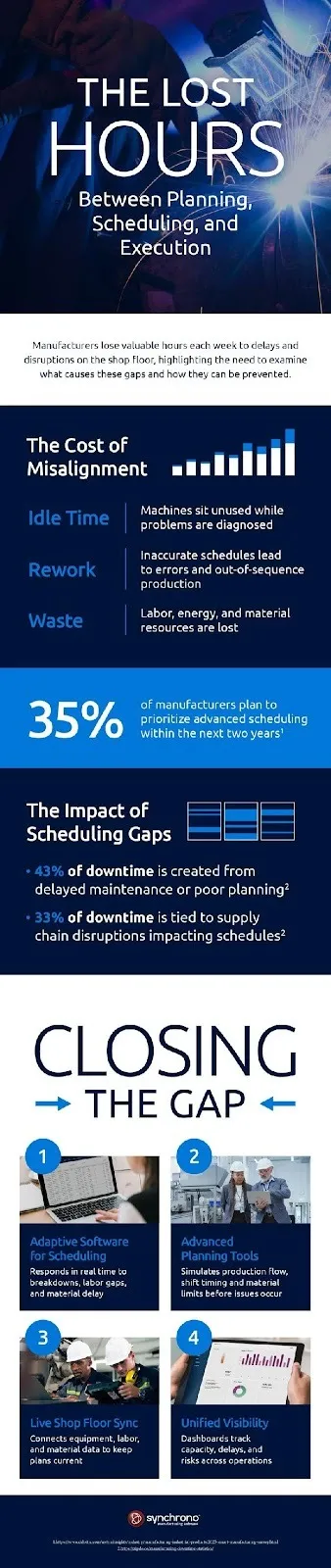
Your plans might be failing because they are built on outdated information, like inaccurate inventory counts or incorrect machine capacity. A disconnect between the planning team and the production floor also means the plan may not reflect real world conditions, causing delays from the start.
Spreadsheets are a major problem because they are static and cannot provide real time visibility. When an unexpected change happens, like a machine breakdown, it is difficult to update and share the new schedule instantly, leaving your teams working with old, incorrect information.
You can start by ensuring all work instructions and documentation are clear, complete, and easily accessible. Implementing a structured system for reporting and escalating problems also helps, as it directs issues to the right person quickly instead of leaving your workers waiting for answers.
Communication is critical. Poor communication between departments, such as planning and production, leads to misunderstandings and rework. Slow communication of schedule changes causes teams to operate on outdated information, creating bottlenecks and slowing down the entire workflow.
