March 11, 2026

September 24, 2026
Editorial Disclaimer
This content is published for general information and editorial purposes only. It does not constitute financial, investment, or legal advice, nor should it be relied upon as such. Any mention of companies, platforms, or services does not imply endorsement or recommendation. We are not affiliated with, nor do we accept responsibility for, any third-party entities referenced. Financial markets and company circumstances can change rapidly. Readers should perform their own independent research and seek professional advice before making any financial or investment decisions.
Business growth brings new opportunities, but it can also introduce additional workplace risks. More employees, larger premises, new equipment and increased workloads can all change the safety requirements of an organisation.
As a company expands, investing in workplace safety should therefore be considered part of its wider growth strategy rather than an issue to address only when problems arise. The right investments can help businesses protect employees, maintain efficient operations and create working environments that are equipped for future expansion.

Falls remain a significant concern in workplaces where employees or contractors need to access roofs, elevated platforms, or other areas at height. Growing businesses should assess these locations carefully and introduce suitable protection before increased activity creates additional exposure to risk.
Collective measures can be particularly valuable because they provide protection without relying solely on individual workers taking specific actions. Installing edge protection barriers around exposed roof edges, for example, can help create a physical boundary between workers and potential fall hazards.
Businesses should also review access routes, fragile surfaces and changes in roof level when considering their overall approach to working at height. This sits alongside the wider question of protecting your business from risk over the long term, where the pattern is the same: identify what could go wrong, put something in place before it does, and make someone accountable for it.
Safety equipment is only one part of an effective workplace strategy. Employees also need to understand the hazards associated with their roles and the procedures designed to control them.
Training should be relevant to the work being carried out rather than treated as a one-off exercise. As a business grows, refresher sessions and additional instruction may be necessary when employees take on new responsibilities or when new machinery and processes are introduced.
Managers and supervisors should also receive appropriate training so that they can identify unsafe practices and respond consistently.
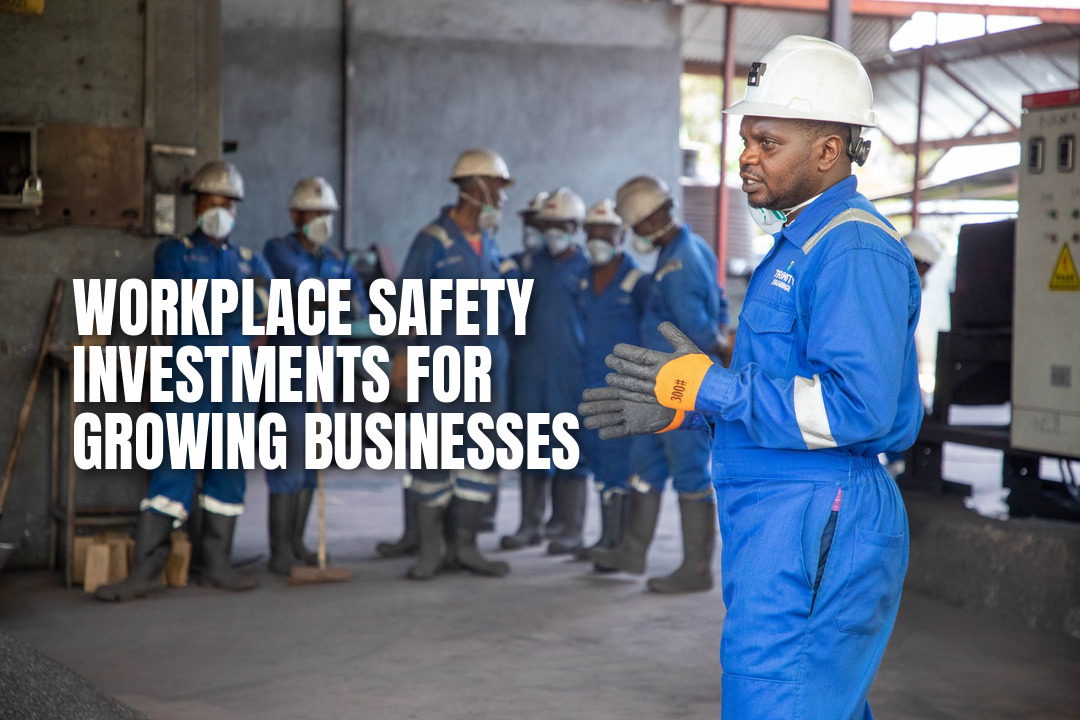
Personal protective equipment (PPE) may be required when workplace risks cannot be adequately controlled through other measures. Depending on the environment, this could include protective footwear, gloves, eye protection, helmets, hearing protection or specialist clothing.
Growing businesses should ensure that PPE is suitable for the specific hazard, properly fitted and maintained in good condition. Regular inspections and straightforward replacement procedures can prevent damaged or unsuitable equipment from remaining in use.
Expansion often involves investing in new machinery, tools or technology. Safety should be considered during the purchasing process rather than after equipment has been installed.
Businesses should look at factors such as guarding, emergency stops, maintenance requirements and operator training. Preventative maintenance programmes are another worthwhile investment, helping organisations identify developing problems before they result in breakdowns or create unnecessary hazards.
As employee numbers increase, existing emergency arrangements may no longer be sufficient. Evacuation routes, fire safety measures, first-aid provision and emergency communication systems should all be reviewed as workplaces change.
Employees need to know what to do and where to go during an emergency. Regular drills can help identify weaknesses in existing procedures while giving new team members practical familiarity with the process.
Workplace safety investments are most effective when they develop alongside the organisation. Instead of waiting for expansion to expose weaknesses, businesses can review risks whenever they add employees, equipment, locations or new working practices. Safety arrangements are one of several systems that tend to break first when a business hires, precisely because they were sized for a smaller operation.
By prioritising fall protection, training, PPE, safe equipment and emergency planning, growing businesses can create a stronger foundation for sustainable expansion while maintaining a safer environment for everyone at work.
More employees, larger premises, new equipment and heavier workloads all alter the risk profile. Arrangements that were adequate for a smaller operation, from evacuation routes to first-aid provision, often stop being sufficient without anyone noticing.
Collective measures such as edge protection barriers create a physical boundary that works whether or not a particular worker takes the right action. Individual measures depend on correct use every time, which makes them less reliable as activity increases.
Treat it as ongoing rather than a one-off induction. Refresher sessions and additional instruction are warranted whenever someone takes on new responsibilities or when new machinery and processes are introduced.
When the risk cannot be adequately controlled by other means. PPE sits at the end of the hierarchy rather than the start, and it only works if it suits the specific hazard, fits properly and is inspected and replaced when damaged.
Guarding, emergency stops, maintenance requirements and the operator training needed to run it safely. Specifying these at the purchasing stage is considerably cheaper than retrofitting them after installation.