
October 3, 2023

January 26, 2026
.webp)
Editorial Disclaimer
This content is published for general information and editorial purposes only. It does not constitute financial, investment, or legal advice, nor should it be relied upon as such. Any mention of companies, platforms, or services does not imply endorsement or recommendation. We are not affiliated with, nor do we accept responsibility for, any third-party entities referenced. Financial markets and company circumstances can change rapidly. Readers should perform their own independent research and seek professional advice before making any financial or investment decisions.
Most teams don't think much about churn until growth starts slowing down. And by then, it's often been building for months.
That’s because churn usually happens way earlier than expected. Users sign up, poke around, get confused or overwhelmed, and quietly disappear. The first 30 days are when users decide if a product is worth their time, and those who experience a quick win tend to stick around. Those who don't will move on to something else, often without ever reaching out to support or leaving feedback.
None of this has to be permanent, though. This article covers why users leave so quickly, the warning signs to watch for, and practical ways to reduce drop-off in that critical first month.

Most early churn comes down to one thing: users never got what they came for.
When someone signs up for a SaaS product, they have something specific in mind. Maybe they want to send cold emails faster, keep projects organised, or automate a task that's eating up their time. If the product doesn't deliver on that promise quickly, they leave.
There are a few common reasons this happens:
Faster than most companies think.
A 2025 benchmark report analysing 547 SaaS companies found that the average time to value is roughly 1 day, 12 hours, and 23 minutes. That's the window users expect before they experience meaningful results from a product.
Every hour beyond that gives users one more reason to second-guess their signup.

The good news is that small improvements early on can make a bigger difference than most teams expect. Dan Wolchonok, Head of Product and Analytics at Reforge, found that a 15% improvement in first-week retention led to nearly twice the number of retained users by week ten. That's a significant difference from a relatively modest early gain.
This is why time to value (TTV) has become a core metric for SaaS products and customer success teams. TTV measures how long it takes a new user to reach their first success with the product. The shorter the TTV, the higher the likelihood of activation and long-term retention.
If users don't "get it" within the first day or two, they often write the product off entirely. Winning them back later is far harder than getting it right the first time.
Churn rarely happens out of nowhere. Users almost always send signals through their behaviour before they cancel. The trick is knowing what to look for.
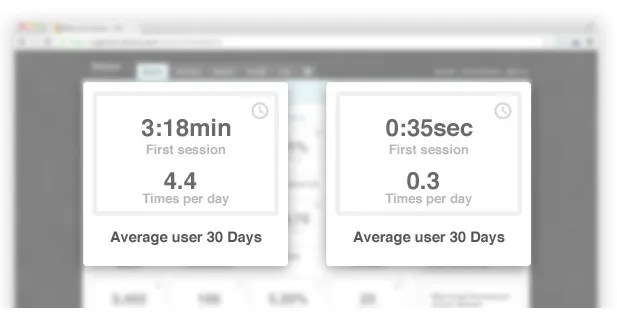
The SaaS startup Groove dug into user activity during the first 30 days and found two metrics that stood out as strong predictors: length of first session and frequency of logins. Users who had short initial sessions and didn't come back often were far more likely to leave.
Here are some other patterns worth tracking:
There's no single fix for early churn. It comes down to getting users to value faster, tracking the right signals, and stepping in before people quietly give up.
Here are a few things worth focusing on:
Figure out the aha moment, then build everything around it
Figuring out what the aha moment looks like starts with comparing users who stuck around to those who didn't. What did retained users do in their first few sessions that churners skipped? Once the pattern becomes clear, the goal is to design onboarding around getting people there faster and cutting anything that doesn't help.
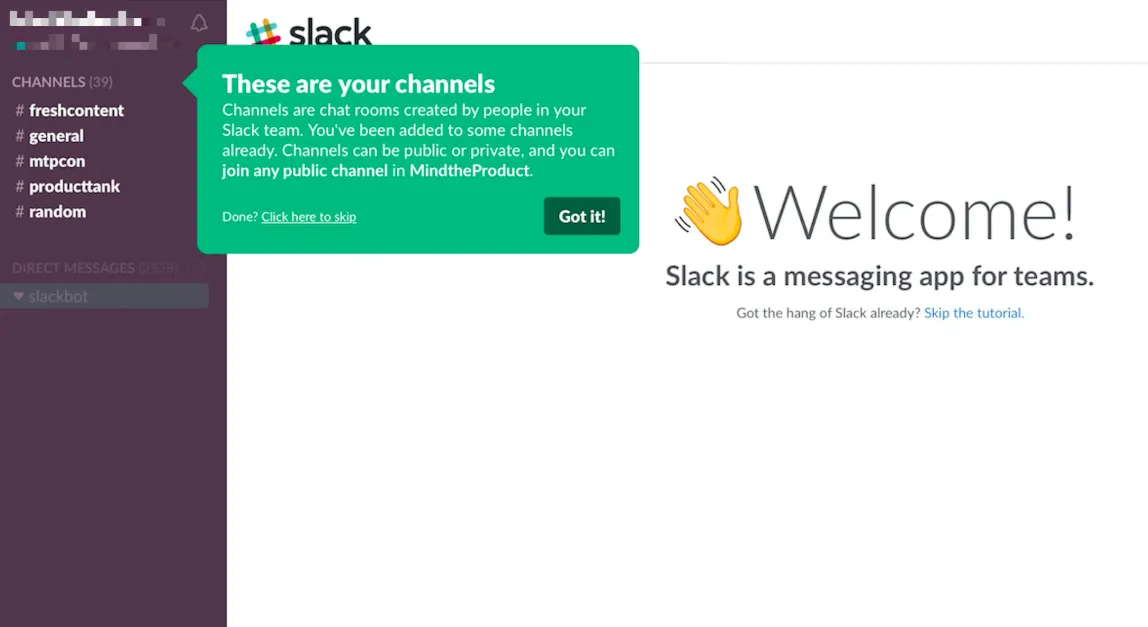
Slack's onboarding is a good example. The whole flow is built around one goal: getting a team to actually start talking in channels. That's the moment where the product clicks, and everything else in the experience points toward it.
Onboarding software gives product teams visibility into how users move through the early experience. It shows where people drop off, which steps they skip, and when engagement starts to fade.
With that data, teams can step in at the right moment: triggering a helpful prompt when someone stalls on a setup step, sending an email when a user goes quiet, or flagging accounts that need personal follow-up before it's too late.
The best tools also let teams build interactive walkthroughs, checklists, and tooltips that introduce features gradually rather than all at once. Users learn by doing instead of reading through a product tour that they'll forget five minutes later.

A generic onboarding flow doesn't serve anyone particularly well. A small business owner signing up for a CRM has completely different goals than an enterprise sales manager using the same product.
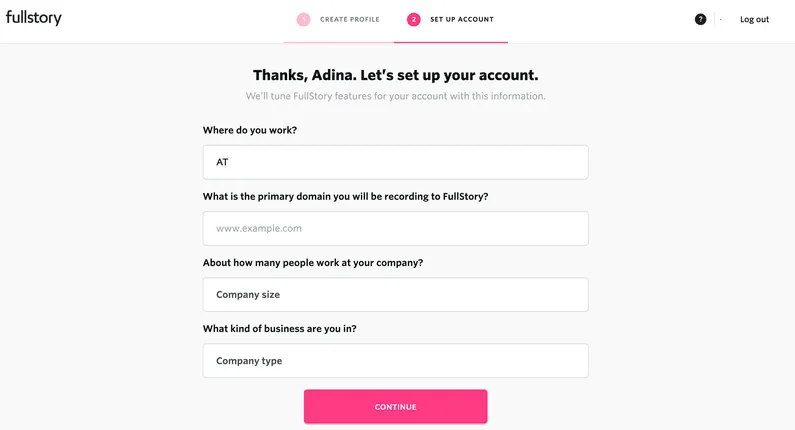
Even something as simple as asking users about their role or goal at signup can make a noticeable difference. When teams tailor onboarding based on role or use case, activation rates tend to increase by 30%-50%, according to industry benchmarks.
Source: Userpilot
Too many companies wait until renewal time to check in with customers. By then, the relationship has often already gone cold.
Proactive check-ins at regular intervals give customer success teams a chance to answer questions, clear up confusion, and remind users of the value they've already gotten from the product. With high-value accounts, especially, this kind of personal outreach can make a meaningful difference in retention.
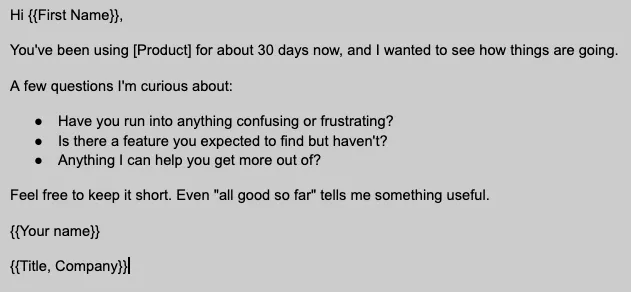
Here's a simple 30-day check-in email that works well as a starting point:
Signups are easy to celebrate, but they don't mean much on their own. A user isn't really onboarded until they've completed the actions that show they understand and have experienced the product's value.
Once you've defined what activation looks like for your product, start tracking how many users get there and how long it takes. If only 20% of signups reach activation within the first week, that tells you something different from if 60% get there, but it takes three weeks. Both scenarios point to different problems and different solutions.
Those two numbers become the foundation for improving onboarding over time. As you make changes, you'll be able to see whether more users are activating, whether they're getting there faster, or both.
Most SaaS teams pour resources into acquisition but put far less into what happens right after signup. But acquisition only pays off if users stick around. Improving activation by even a small margin often delivers a better return than adding more leads at the top of the funnel because every retained user is one you've already paid to acquire.
It's also worth accepting that some churn isn't fixable. Users who signed up for a free trial without understanding the product, or who were never a good fit in the first place, were unlikely to convert, no matter how polished the onboarding. Most teams already have a product worth keeping. The challenge is making sure new users stay long enough to agree.
The primary reason is a failure to experience value. When a user signs up, they have a specific problem to solve. If your product doesn't quickly and clearly show them how it solves that problem, they lose interest and move on, often within the first few sessions.
Much faster than you might think. Studies show the average time to value is about a day and a half. Your onboarding must be efficient enough to guide users to a meaningful outcome within this critical window to maximise retention.
You can often predict churn by looking at user behaviour. Key warning signs include not completing essential setup steps, having very short session times, a sudden drop-off in logins after the first week, and not using the product's main features.
The most effective strategy is to identify your product's “aha moment” and design the entire onboarding experience around getting users there as quickly as possible. Cut out unnecessary steps and use tools like interactive walkthroughs to guide them directly to the feature that delivers core value.
While acquiring new users is important, improving retention often provides a better return. Retaining a user you've already paid to acquire is more cost-effective than constantly filling a leaky bucket. As business coaches at Robin Waite Limited often advise, focusing on early activation builds a more sustainable growth model.
