June 6, 2025

July 29, 2026
Editorial Disclaimer
This content is published for general information and editorial purposes only. It does not constitute financial, investment, or legal advice, nor should it be relied upon as such. Any mention of companies, platforms, or services does not imply endorsement or recommendation. We are not affiliated with, nor do we accept responsibility for, any third-party entities referenced. Financial markets and company circumstances can change rapidly. Readers should perform their own independent research and seek professional advice before making any financial or investment decisions.
Trade shows give businesses a valuable opportunity to introduce products, strengthen brand awareness, and connect with potential customers face to face. With dozens or even hundreds of exhibitors competing for attention, a thoughtfully planned display can make a meaningful difference. Every element, from the booth layout to the messaging, should work together to encourage visitors to stop, ask questions, and learn more about the company.

Visitors often decide within seconds whether they want to approach a booth. Strong branding helps create an immediate impression by using consistent colours, logos, fonts, and graphics that align with the company's overall identity, and it is one of the more dependable ways to improve business visibility at a busy event.
Messaging should also be concise. Rather than filling displays with lengthy paragraphs, focus on a clear headline and a few supporting points that communicate the company's value quickly. High-quality images and simple graphics are generally easier to absorb in a busy exhibition hall than large blocks of text.
An attractive booth should also be easy to enter. Furniture, product displays, and demonstration areas should create an open layout that invites attendees inside instead of forming physical barriers.
Interactive product demonstrations, touchscreens, or sample stations encourage visitors to spend more time at the booth. Staff members should have enough space to move comfortably while engaging in conversations without creating congestion. Providing a dedicated area for longer discussions can also be helpful when meeting with qualified prospects or existing clients during busy events.
Every display component should support the overall presentation while remaining practical to transport and assemble. Portable structures, modular displays, and lightweight materials simplify setup and allow businesses to adapt their booth for different event sizes.
Signage also plays an important role in attracting attention. Well-placed event banner stands can highlight promotions, showcase new products, or reinforce key brand messages while remaining easy to reposition throughout the event. Selecting display materials that are durable and reusable also helps maximise the value of future trade show investments.
Even the best booth design cannot replace knowledgeable and approachable staff. Team members should understand the company's products, ask thoughtful questions, and adapt conversations to each visitor's interests rather than relying on scripted presentations.
Having printed materials, digital resources, or product samples readily available allows conversations to continue after the event. Staff should also establish a consistent process for collecting contact information and documenting follow-up actions while discussions are still fresh.
The success of a trade show extends beyond the number of people who visited the booth. Businesses should review lead quality, scheduled meetings, product demonstrations, and post-event sales opportunities to evaluate overall performance, which also helps surface the common lead generation mistakes that quietly waste an exhibition budget.
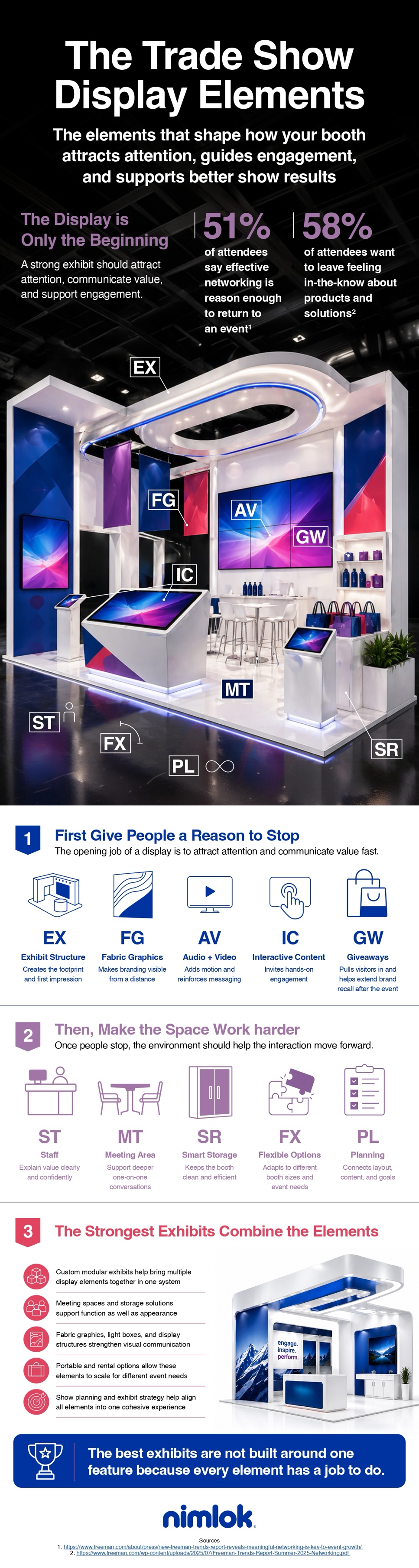
Gathering feedback from both attendees and booth staff can identify opportunities to improve future displays, messaging, and engagement strategies. A well-planned trade show display is more than a collection of visual elements. When branding, layout, materials, and personal interactions work together, businesses create memorable experiences that strengthen relationships and support long-term growth. Look over the infographic below for more information.
Costs vary widely by stand size and format. Portable and modular systems are generally the lowest-cost route because they can be reused across multiple events without new fabrication.
As little as possible. One clear headline and a few supporting points work better than paragraphs, because most visitors read from a distance while walking past.
Blocking the entrance. Placing tables, product plinths or staff across the front of the stand discourages people from stepping in.
Within a few days, while the conversation is still recent for both sides. Notes recorded at the stand make that follow-up specific rather than generic.
Compare lead quality, meetings booked, demonstrations given and resulting sales against the total cost of attending, rather than counting visitors to the stand.
