April 16, 2026

May 21, 2026
Editorial Disclaimer
This content is published for general information and editorial purposes only. It does not constitute financial, investment, or legal advice, nor should it be relied upon as such. Any mention of companies, platforms, or services does not imply endorsement or recommendation. We are not affiliated with, nor do we accept responsibility for, any third-party entities referenced. Financial markets and company circumstances can change rapidly. Readers should perform their own independent research and seek professional advice before making any financial or investment decisions.
The questions people have about business coaching are remarkably consistent. What does it actually cost? Is it really worth it? How is it different from mentoring? When is the right time to invest? The answers they find online are often vague, hedged, or promotional. This article provides direct, honest answers to the most common questions Robin hears from business owners considering coaching for the first time. No softening. No waffle. Just Robin's actual position, drawn from more than 20 years of coaching coaches, consultants, and service business owners across the UK and internationally.

Business coaching is a professional relationship in which the coach helps a business owner identify specific goals, work through the obstacles between their current situation and those goals, and build the accountability structures needed to make the change stick.
It is not therapy. It is not motivational speaking. It is not consulting. Good business coaching is specific, measurable, and outcome-focused. The coach does not run the business for you. They create the conditions under which you can run it better.
Robin's coaching, specifically, works from the assumption that most business owners already know what needs to change. The gap is not information: it is confidence, clarity, and accountability. The coaching process provides all three.
For a detailed breakdown of what business coaches actually do session by session, the guide to what a business coach actually does covers this in full.
UK business coaching fees range from under £100 per hour at the low end to £500 to £800 per session for well-positioned coaches in premium niches. Group coaching programmes typically range from £200 to £1,000 per month depending on the depth of support, the size of the group, and the coach's track record.
The honest answer is that the cost varies enormously, and the variation is not primarily driven by years of experience or formal qualifications. It is driven by positioning and pricing confidence. A coach who has a clear offer, a defined niche, and a track record of specific outcomes will charge more than one who describes their services broadly and charges by the session.
The more relevant question is not what coaching costs but what it will cost you not to do it. If a coaching relationship helps you raise your prices by 30% and retain the same number of clients, the investment typically pays for itself within the first month or two. For specific data on what the market charges, the guide to business coaching charges in the UK provides a detailed breakdown by coaching type and engagement model.
Yes, when it is the right coaching relationship at the right moment. The ICF's Global Coaching Client Study found that 86% of organisations reported a positive return on coaching investment, with a median ROI of approximately 7x the cost of the engagement.
Robin's position is more specific: the ROI from business coaching is primarily determined by two factors. First, the alignment between the coach's expertise and the client's actual problem. A coach who specialises in pricing and offer design is the right fit for a business stuck at the pricing ceiling, not a generalist coach who covers everything broadly. Second, the client's willingness to implement. Coaching is not passive. The frameworks and accountability a coach provides only create results when the business owner acts on them.
The members of the Fearless Business Accelerator who achieve the most measurable outcomes are not the ones who started with the most skill. They are the ones who implemented consistently and held themselves to the accountability that the coaching structure provided.
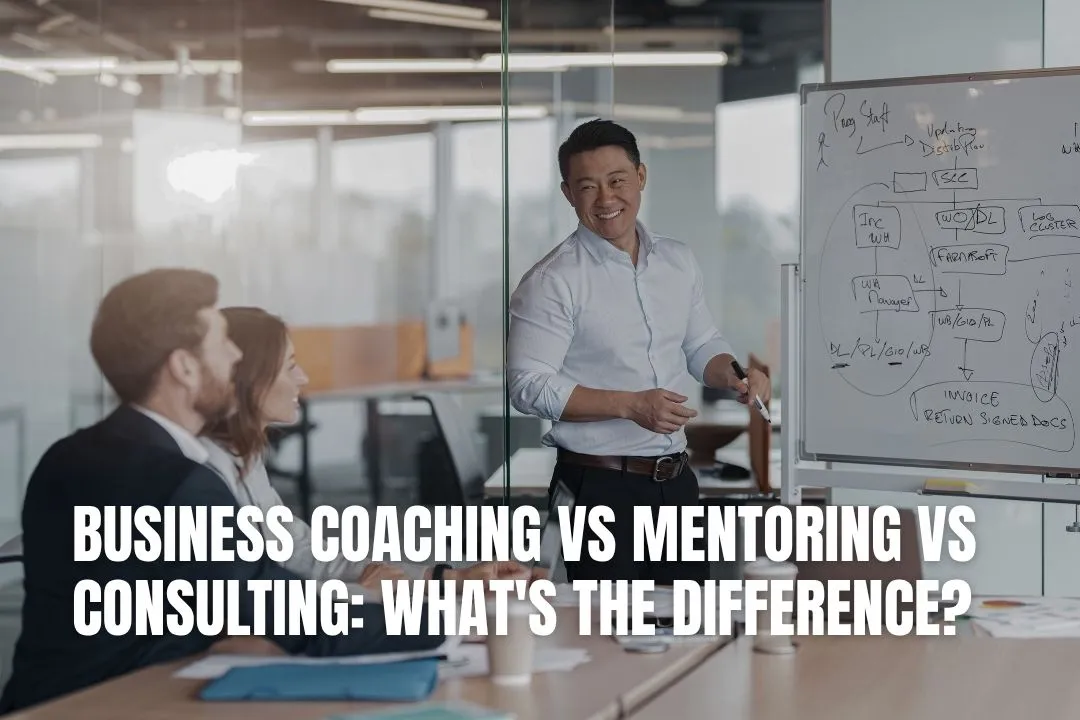
These three roles are often confused, and the confusion is understandable because the lines can overlap in practice. Here is Robin's clear working definition of each.
A business coach: Helps you figure out what to do and holds you accountable for doing it. The coach asks questions, challenges assumptions, and creates a structure in which your own thinking can become clearer and more actionable. The expertise is in the coaching process and the frameworks, not in doing the work for you.
A mentor: Has been where you are trying to go and shares the benefit of their experience. Mentoring is more advisory: the mentor shares what worked for them and what did not. It is typically more informal and less structured than coaching.
A consultant: Is hired to solve a specific problem using their expertise. They tell you what to do, and sometimes do it for you. The outcome is a deliverable or a recommendation, not a change in your capability to run the business.
All three have value. They are not interchangeable. Robin operates primarily as a coach: his goal is to improve the business owner's ability to run their business, not to run it for them. But his coaching is informed by 20 or more years of business experience, which means the line between coaching and mentoring blurs at times.
The first meaningful result from business coaching can come within weeks. A clear offer and a raised price, implemented after the first or second coaching conversation, can change the financial picture of a business almost immediately.
The deeper transformation, including the mindset shifts, the productised service, the recurring revenue base, and the pricing model that holds under pressure, typically takes three to twelve months to fully embed. Robin's coaching programmes typically run for six months because that is the minimum time required to see a productised offer move from concept to a proven, consistently priced reality.
The speed of results depends almost entirely on the business owner's willingness to implement. Coaches who apply the frameworks quickly see results quickly. Coaches who attend every session and delay implementation see progress much more slowly.
This is the question that most often delays the decision that would solve the problem. The business owner who believes they cannot afford a coach is often in exactly the position where coaching would be most valuable: undercharging, uncertain about their offer, and stuck in a revenue plateau that they cannot break out of alone.
Robin's consistent observation is that the coaches and consultants who say they cannot afford coaching typically cannot afford not to have it. A six-month programme that helps a consultant raise their pricing by 30% and retain four clients at the new rate has paid for itself before the programme ends.
The right question is not whether the investment is affordable. It is whether the return justifies the investment. Apply the same logic to coaching that Robin applies to pricing: what is the financial outcome of this engagement likely to be, and is the fee approximately 10% of that figure? If yes, it is a good investment. If not, ask the coach to walk you through their typical client outcomes before deciding.
If you want to get a sense of Robin's approach before making any investment decision, grab a free signed copy of Take Your Shot. It is the clearest expression of the philosophy and frameworks behind his coaching, and it is free.
A business coach helps you explore challenges and figure out your own solutions, creating a structure to hold you accountable for taking action. In contrast, a consultant is hired for their specific expertise to solve a problem for you; they tell you what to do and sometimes do the work themselves.
The cost varies significantly. You might find coaches charging under £100 per hour, while well-positioned specialists in premium niches can charge £500 to £800 per session. Group coaching programmes usually fall between £200 and £1,000 per month.
You can see meaningful results very quickly, sometimes within weeks, especially after implementing initial advice on things like pricing. However, for deeper transformations like building a recurring revenue model, expect it to take three to twelve months. Your speed of progress depends on how quickly you act on the advice.
Yes, when you find the right coach for your specific needs and are ready to implement the changes. The International Coaching Federation found that 86% of companies reported a positive return on their investment, with a median return of about seven times the initial cost.
The best time is often right now, especially if you feel stuck. Many business owners wait until they think they can 'afford' it, but this delay prevents them from solving the very revenue problems that a coach, like those at Robin Waite Limited, could help them fix.